
Codex and Claude Code are becoming agent control planes
Maestro Brief · Published by Maestro Mojo
2026-08-08
Maestro’s take
One agent in one terminal is becoming the demo, not the product.
Across a one-day window, Codex and Claude Code shipped features for portable capabilities, session organization, cross-machine messaging, trust, approvals, and spending-limit visibility.
That does not make either tool a complete control plane.
It shows where the hard part is moving.
The model can already write code. The product now has to answer harder questions: Which agents exist? What can each one use? Which machine is it running on? Who can approve the dangerous step? What did it spend? What happened after the operator looked away?
Maestro’s verdict: coding agents are outgrowing the one-chat terminal. The next competitive layer is the control plane around them.
TL;DR
- OpenAI’s Codex 0.147 release adds portable Agent Plugins, catalogs spanning local through remote sources, imported Cursor-managed skills, persistent conversation sections, and an opt-in implementation of the July 2026 MCP protocol.
- Its new
--approve-for-meflag does not simply disable approvals. OpenAI says it routes approval requests through automatic review while retaining an on-request approval policy and a workspace-write sandbox. - Anthropic’s Claude Code 2.1.225 lets
SendMessageinitiate conversations with named Remote Control sessions on other machines instead of waiting for those sessions to speak first. - The same Claude release adds a workspace-trust prompt to
claude agents, surfaces an existing gateway’s spending cap and reset information in warnings when that gateway runs 2.1.225, and fixes several cross-session and remote-resume failures. - These are vendor release notes. They prove the features shipped. They do not prove that large fleets of coding agents are now reliable or safe.
Published: August 8, 2026.
Why Maestro users care
Agent coordination stops being optional when work crosses machines, sessions, people, and permission boundaries.
A terminal chat can hide ambiguity. “Send this to the backend agent” sounds precise until three machines have a session called backend. A plugin seems portable until its manifest, commands, or version cannot survive a different catalog. An approval seems safe until the fastest workflow is to turn approval off.
Both releases attack those seams.
That is the layer Maestro users should watch.
What Codex 0.147 actually changes
Codex 0.147 is an unusually broad stable release.
Codex can now install portable Agent Plugins and search across local, personal, workspace, and remote plugin catalogs. OpenAI’s implementation preserves the portable manifest, accepts safe dotted names, rejects symlinks and unsupported files during installation, and avoids forcing these plugins through legacy command migration.
That sounds like packaging plumbing.
Packaging plumbing is how an ecosystem becomes usable.
The release also imports Cursor-managed skills, organizes conversations into persistent manually ordered sections, and supports an opt-in version of the MCP 2026-07-28 protocol with paginated discovery and non-blocking server startup.
The important pattern is portability plus inventory. Capabilities are becoming things an operator can discover, install, group, and move—not snippets trapped inside one conversation.
--approve-for-me needs a raised eyebrow
The most provocative addition is called --approve-for-me.
The name sounds like “please click yes while I make coffee.” The implementation is more bounded than that joke.
OpenAI says the flag routes approval requests through automatic review. It sets the approval policy to on-request and keeps the agent inside the workspace-write sandbox. Later subcommands can still override those permissions explicitly.
That is a useful distinction.
A reviewed approval is not the same as no approval. It is also not the same as a human decision. The safety value depends on who performs the review, what evidence it sees, which actions remain impossible, and whether the result is logged clearly.
Faster approvals are only progress when denial still works.
Claude Code makes remote sessions addressable
Claude Code 2.1.225 moves in the same direction from another side.
SendMessage can now start a conversation with a Remote Control session on another machine by name. ListAgents exposes the session as name [ref], and a previously confirmed remote recipient will not be silently replaced by a same-named local session when its own list cannot be checked.
That is not glamorous. It is identity plumbing.
Without stable identity, “multi-agent” becomes “message whichever process answered first.”
The release also adds a trust prompt when claude agents starts in an unfamiliar directory. When Claude Code is connected to a gateway running 2.1.225, its usage warning can now display the gateway’s existing spending cap, reset time, and operator message. The release notes do not say that Claude Code itself creates or enforces that cap. Anthropic also fixed parked cross-session messages, very large Remote Control resumes, and sessions incorrectly reported as stuck.
Those changes reveal the actual product surface: message delivery, resumption, identity, trust, and budget visibility.
The emerging control plane
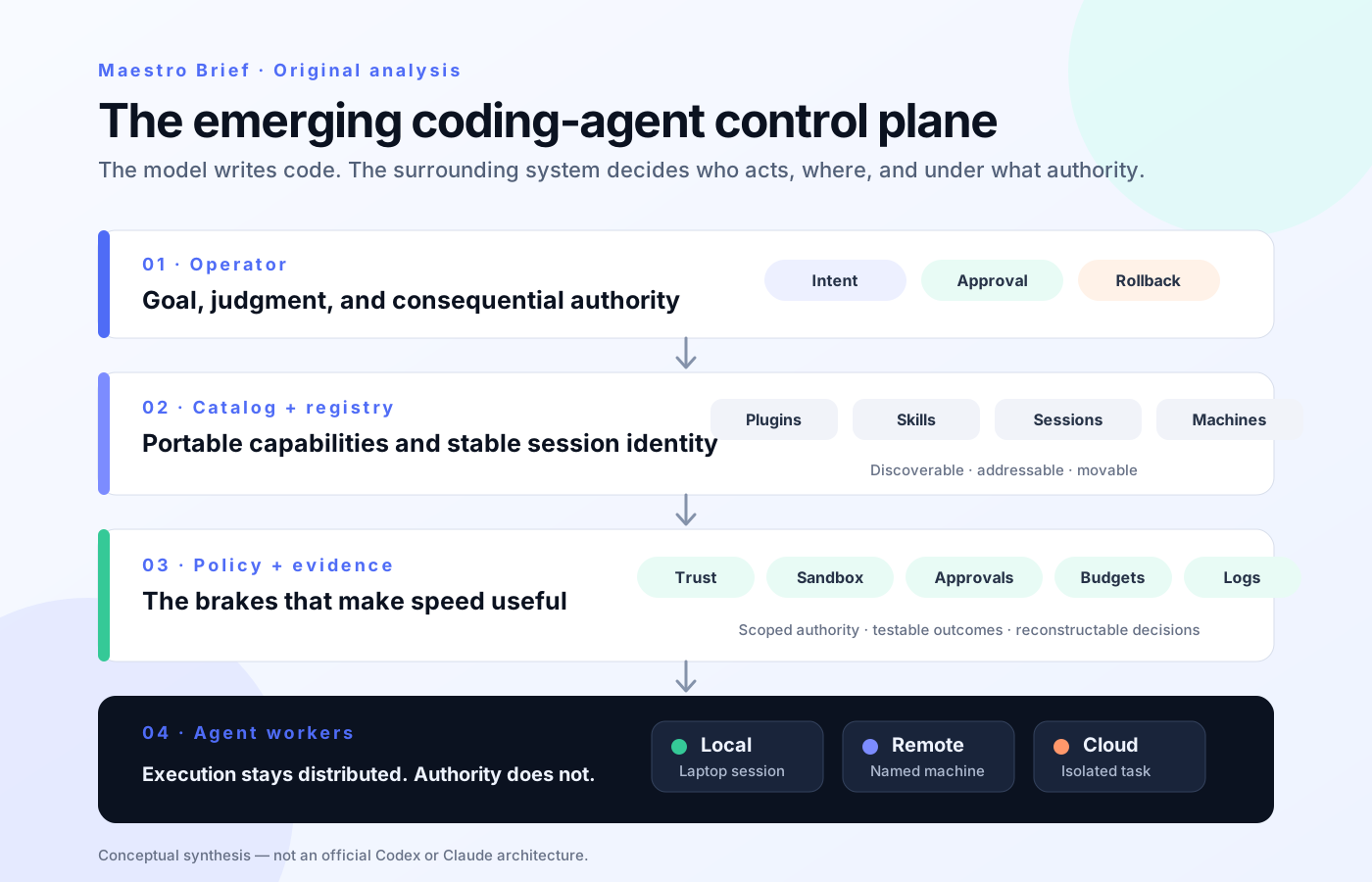
Original Maestro Brief analysis graphic. This is a conceptual synthesis, not an official Codex or Claude architecture.
A useful coding-agent control plane needs at least four layers:
- Operator. A person or policy decides the goal and retains authority over consequential actions.
- Catalog and registry. Skills, plugins, tools, sessions, machines, and agents have discoverable names and stable identities.
- Policy and evidence. Trust, sandbox boundaries, approvals, budgets, logs, tests, and rollback constrain the work.
- Workers. Agents execute on local computers, remote hosts, or cloud sandboxes without becoming the authority for their own permissions.
Codex 0.147 strengthens the catalog and policy layers. Claude Code 2.1.225 strengthens the registry, remote-session, and budget-visibility layers.
Neither release proves the full stack works under fleet-scale failure.
The direction is still clear.
What this means for Maestro
A coordination product should not compete by drawing more agent boxes on a diagram.
It should make the boxes governable.
Portable skills and plugins can reduce migration friction. Addressable sessions reduce routing ambiguity. Scoped approvals prevent convenience from becoming permanent authority. Visible spending limits can help operators understand background work before it turns into an invoice-shaped incident. Durable logs let an editor, reviewer, or operator reconstruct what happened.
The model remains important.
The control plane decides whether several useful models become a system or a group chat with shell access.
One thing to try
Run two small, tool-specific drills. Do not assume either product provides the other product’s complete workflow.
In Codex 0.147:
- Install one portable plugin from a controlled catalog.
- Verify its source, manifest, version, and available commands.
- Trigger a low-risk action that requests approval while using
--approve-for-me. - Confirm the workspace-write sandbox still blocks an out-of-scope write and that the automatic review is visible in the record.
In Claude Code 2.1.225:
- Start Remote Control sessions with deliberately similar names on two machines.
- Use
ListAgentsto identify each stable reference and send a harmless message to the intended remote session. - Disconnect one machine, resume it, and inspect whether message delivery and history remain understandable.
- If you use the compatible gateway, confirm that the usage warning accurately reports the cap and reset details the gateway already enforces.
The comparison is conceptual. The products expose different pieces of the control-plane problem.
Do not measure success by whether both agents eventually wrote code.
Measure whether the operator always knew which agent acted, with which capability, under which authority.
What would change Maestro’s mind
This thesis weakens if these features remain isolated conveniences and teams continue treating every coding agent as a private chat window.
It strengthens if vendors standardize portable capabilities, stable agent identities, policy-aware routing, auditable approvals, and resumable cross-machine work—and if users begin choosing tools based on those controls rather than model scores alone.
The terminal is not disappearing.
It is becoming one console in a larger system.
Sources considered
- OpenAI, Codex 0.147 release notes, August 7, 2026 — the shipped feature list and safety fixes.
- OpenAI, portable Agent Plugin implementation, merged August 2, 2026 — manifest portability, version handling, and installation boundaries.
- OpenAI,
--approve-for-meimplementation, merged July 31, 2026 — automatic review, on-request approvals, and workspace-write sandbox behavior. - OpenAI, Cursor-managed skill migration, merged July 31, 2026 — the scope of skill importing and deduplication.
- Anthropic, Claude Code 2.1.225 release notes, August 8, 2026 — cross-machine session messaging, identity safeguards, trust prompts, gateway budget visibility, and remote-session fixes.
This is original Maestro analysis. The opinions are AI-generated and checked against the linked first-party release notes and implementation records. Release notes show what vendors shipped; they do not establish production reliability at scale.