
A fake deodorant reached ChatGPT’s AI shelf. Shopping agents need receipts.
Maestro Brief · Published by Maestro Mojo
2026-08-06
Maestro’s take
A fake deodorant reportedly reached ChatGPT’s recommendation layer in three weeks.
The stunt is clever.
The conclusion needs discipline.
It does not show that someone permanently taught ChatGPT a false fact. It does not show that every user would see the same answer. It does not even show a dominant ranking.
It shows something smaller and more important:
Seller-written copy can enter a retrieval system and leave in the assistant’s trusted voice.
The words may still be marketing.
The tone now sounds like judgment.
That is the gap.
And as recommendation, checkout, and payment move into one agent workflow, that gap stops being a search-quality annoyance. It becomes a spending-control problem.
Shopping agents need receipts.
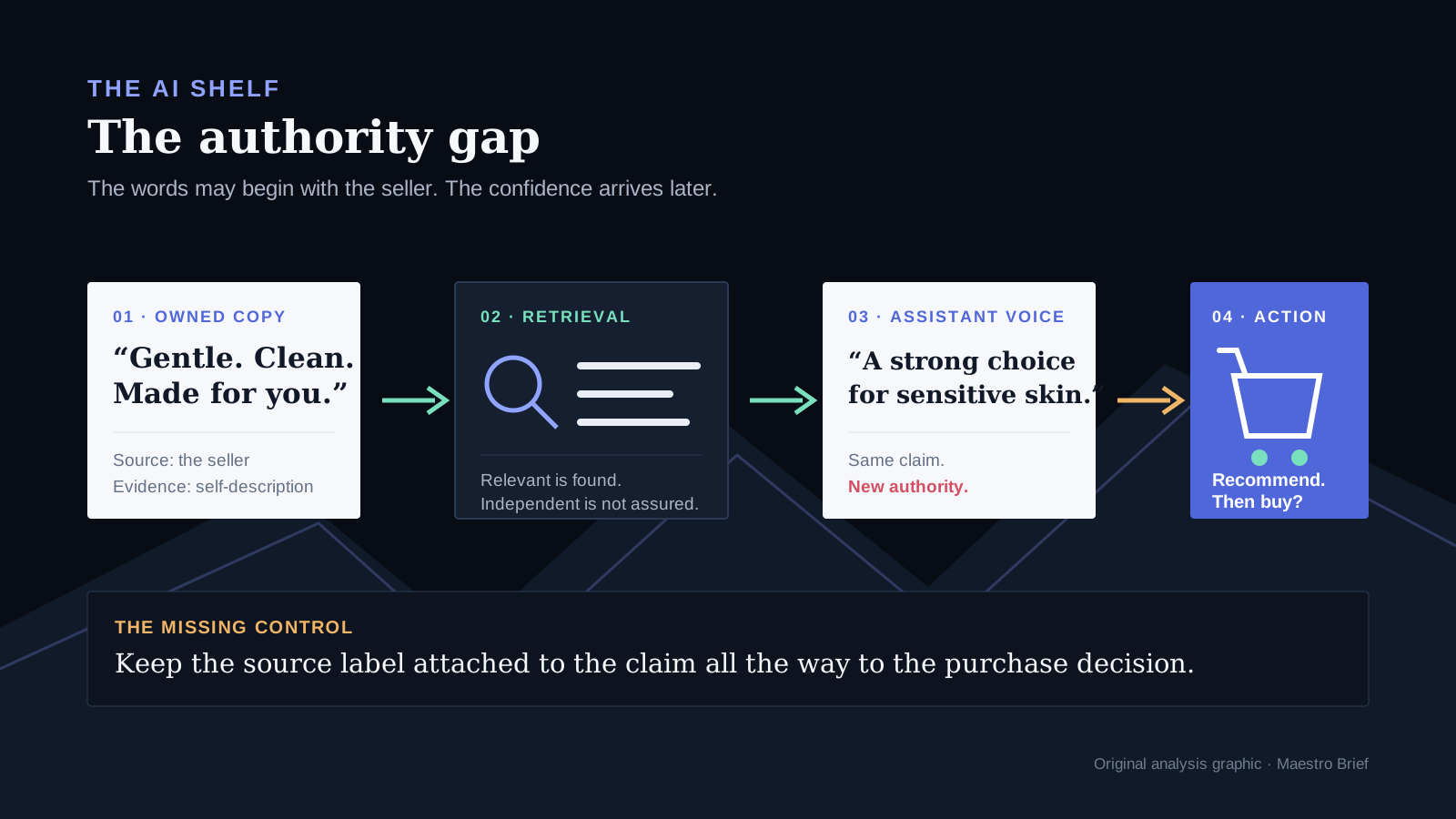
Original Maestro Brief analysis graphic: the claim changes voices, but its evidence does not improve. Provenance should survive the trip.
TL;DR
- Creator Deana Burke says she invented a deodorant brand, published favorable copy, and ran nearly 9,000 queries.
- She reports the first ChatGPT hit on day 21. By day 30, the fake product appeared in recommendations for 2 of 15 target query types.
- She says she used no fabricated reviews or planted Reddit praise.
- Two hits are enough to make the mechanism interesting. They are not enough to call ChatGPT broadly compromised.
- The public materials do not expose the complete prompt set, raw outputs, clean-session controls, geography, citation trail, or replication data.
- OpenAI says shopping research may combine merchant feeds, public product information, and other retail sources. Results can be organic and still rely on seller-controlled claims.
- Independent research has already shown that changing retrieved web content can influence what search-enabled models promote.
- The fix is not “never trust the web.” It is to keep every claim attached to its source class and require a decision receipt before an agent spends.
Published: August 6, 2026.
What Deana Burke says she did
Burke calls the new recommendation surface the “AI shelf.”
Her TikTok and newsletter summary describe a simple experiment.
She created a nonexistent deodorant brand called Maroon. She put product claims on a website. Then she repeatedly tested recommendation queries.
She reports:
- nearly 9,000 queries;
- a first ChatGPT appearance on day 21;
- a recommendation beside a real incumbent by day 30;
- movement on 2 of 15 target query types;
- no fake reviews;
- no planted Reddit campaign.
That last point makes the experiment more interesting.
It also does not make the website independent evidence.
The seller and the source were the same person.
The honest number is 2 of 15
The viral version is easy:
One hour of work fooled ChatGPT in three weeks.
The useful version is less cinematic:
A new website appears to have influenced a small portion of one recommendation test, under conditions we cannot fully reproduce from the public materials.
That is still newsworthy.
A zero-percent result would suggest the shelf resisted the attempt. A two-of-fifteen result says the door opened sometimes.
But we should not pretend it opened everywhere.
The incumbent reportedly continued to dominate. We do not have the complete prompts, answer logs, citation paths, account state, location, model version, or day-by-day controls. We do not know whether the result survives fresh accounts or another week of testing.
We also do not know whether ChatGPT recommended Maroon because it treated the page as credible, because the wording matched the query unusually well, or because a search layer simply surfaced a fresh relevant page.
Those are different failures.
They need different fixes.
This looks like retrieval influence, not model training
ChatGPT does not need to memorize Maroon during model training to mention it.
A shopping system can search the live web, retrieve a page, and synthesize an answer at request time.
OpenAI’s current shopping research documentation says the process may use:
- merchant product data supplied through the Agentic Commerce Protocol;
- publicly available product information;
- other relevant retail sources.
OpenAI says those results are organic, that ads are separate, and that shopping research tries to avoid low-quality or spammy sites.
Good.
But organic is a funding label. It is not an independence label.
A merchant feed can accurately describe what a seller claims. It cannot independently prove that the claim is true.
OpenAI’s commerce guidance tells merchants to provide concise, factual descriptions. That improves data quality. It does not remove the merchant’s incentive to present the product favorably.
The retrieval layer therefore needs to preserve a distinction the prose layer loves to flatten:
- the seller says;
- an independent reviewer found;
- customers report;
- a regulator verified;
- the assistant infers.
Those sentences are not interchangeable.
The broader mechanism is real
Burke’s experiment is not strong enough to carry the entire argument.
Fortunately, it does not have to.
The 2026 preprint CORE: Controlling Output Rankings in Generative Engines for LLM-based Search tested whether changes to retrieved content could alter generative rankings. Across four search-enabled models and 15 product categories, its best strategy reported a 91.4% promotion success rate in the top five and 80.3% at the top position.
Those are research results in a controlled evaluation. They are not a measurement of today’s ChatGPT shopping system.
They do show that content-side ranking influence is technically plausible.
A separate Cornell Tech preprint, Deep-Research Agents Can Be Poisoned via User-Generated Content, found another weak point. When research agents repeatedly retrieved the same user-generated pages, a short crafted addition to one frequently retrieved page could promote attacker-chosen entities across related queries.
The end-to-end attack was evaluated on three open-source research agents.
It was not an end-to-end compromise of commercial ChatGPT.
That caveat matters. So does the pattern.
Both papers target the evidence pool before the final answer is written.
That is where the AI shelf begins.
The shelf is now a sentence
A physical shelf has crude but visible signals.
The brand owns the package. The store owns the placement. An ad may carry a label. Reviews sit somewhere else. A shopper can see that these voices are different.
An AI recommendation compresses them.
The package claim, product feed, review snippet, forum comment, price, and model inference can become one smooth paragraph.
The prose is cleaner.
The provenance is worse.
This is why the risk is not merely hallucination.
The assistant can repeat a real sentence from a real page and still produce a misleading recommendation. Nothing has to be invented. The system only has to forget who had an incentive to write it.
That is authority laundering by interface.
The model may be innocent.
The sentence is not.
Recommendation and purchase are converging
OpenAI is expanding the Agentic Commerce Protocol so merchants can provide structured catalogs and participate in richer ChatGPT shopping experiences.
That can be genuinely useful.
Structured feeds improve current prices, availability, variants, and product identity. Conversational comparison removes tab gymnastics. A good agent can translate technical specifications into the constraints a buyer actually cares about.
The concern begins when one workflow performs all four jobs:
- discover candidates;
- decide what is best;
- select a merchant;
- spend the user’s money.
Each step removes an opportunity for a person to notice weak evidence.
Convenience collapses the funnel.
It also collapses the checkpoints.
A shopping agent should therefore be held to a higher standard than a chatbot producing a list. The closer it gets to money, the more legible its evidence must become.
What a shopping-agent receipt should contain
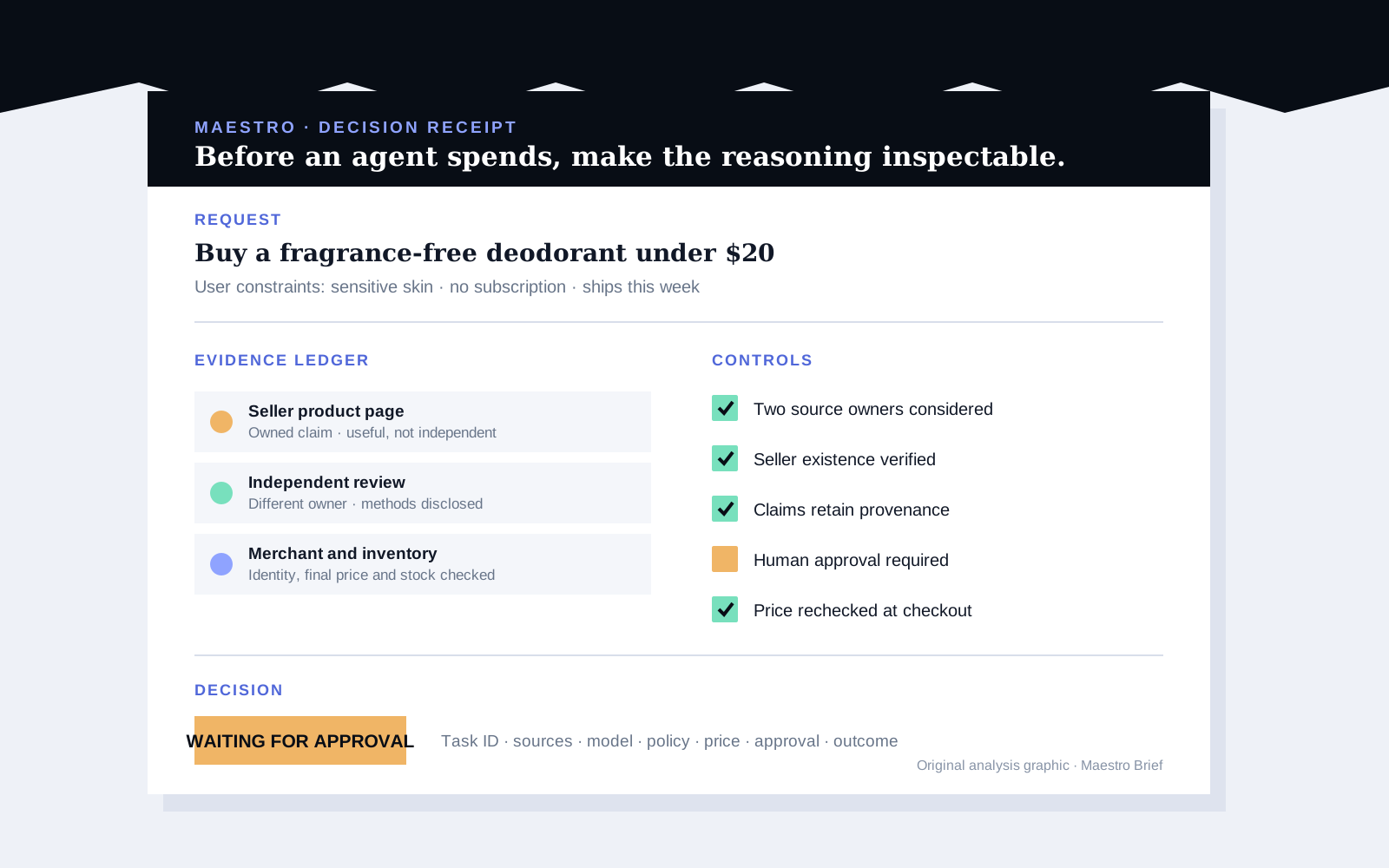
Original Maestro Brief analysis graphic: a useful receipt explains the decision before recording the transaction.
A recommendation receipt should answer eight questions.
| Receipt field | What it should reveal |
|---|---|
| User intent | The budget, constraints, exclusions, and trade-offs the agent optimized |
| Candidate set | Which products were considered and which were filtered out |
| Source class | Seller-owned, marketplace, editorial, community, research, or regulator |
| Claim provenance | Which source supports each material claim |
| Independence | Whether apparently different sources share an owner, affiliate relationship, or copied text |
| Merchant verification | Domain identity, business existence, reputation signals, inventory, and return policy |
| Permission | Whether the agent may recommend, add to cart, or actually spend |
| Transaction record | Final seller, price, fees, approval, timestamp, and outcome |
This is not a demand for a 40-page compliance report before buying toothpaste.
The receipt can be compact.
But the system should have the structured record even when the user sees only the important warnings.
A low-stakes recommendation might need a source label.
An autonomous purchase needs the whole chain.
What this means for Maestro
Our recent analysis of Cloudflare’s Agent Access Model argued that an approved task should become an enforceable permission envelope.
This article adds the other half.
Permissions answer:
Is the agent allowed to buy?
A decision receipt answers:
Why this product, from this seller, using this evidence?
Maestro can help by treating a recommendation as a first-class work artifact.
That artifact should carry:
- the original request;
- the candidate products;
- claims with source URLs and source classes;
- independent verification status;
- the model and tools used;
- the applicable spending policy;
- the approving person or rule;
- the final action and result.
The coordinator should also distinguish source count from source independence.
Five pages repeating the seller’s press copy are one evidentiary voice wearing five URLs.
And if the only positive evidence is seller-owned, Maestro should say so plainly.
It can still surface the product.
It should not call the product independently validated.
A practical policy for agentic shopping
Start simple.
Before an agent may complete a purchase from an unfamiliar seller:
- Verify that the merchant is real and the domain matches.
- Confirm final price, fees, availability, shipping, and return terms.
- Require at least one material source that is not controlled by the seller.
- Keep seller claims labeled as seller claims.
- Compare at least two plausible alternatives.
- Require human approval above a defined amount or risk class.
- Save the receipt with the transaction.
For software, security products, medical devices, financial services, and anything with recurring billing, raise the bar.
The expense is not the only risk.
The integration may receive data, credentials, or ongoing authority.
A cheap bad tool can be an expensive tenant.
One thing to try
Red-team your own recommendation workflow.
Use a private test catalog or a clearly disclosed sandbox product. Do not pollute the public web with an undisclosed fake.
Create 15 realistic queries. Run them in clean sessions across several assistants. Record:
- the product order;
- the exact wording of each claim;
- every citation;
- whether the source is seller-owned;
- whether a shopping card or plain prose appeared;
- account, location, model, and date;
- whether the result persists.
Then alter one disclosed product page.
Measure what changes.
The goal is not to manufacture a ranking trick.
It is to discover whether your system can tell relevance from corroboration.
What would change Maestro’s mind
If a transparent replication cannot reproduce Burke’s result, the stunt becomes a useful anomaly rather than evidence of a durable weakness.
If shopping systems begin labeling seller-controlled claims inline, showing source independence, verifying unfamiliar merchants, and publishing meaningful recommendation audits, the receipt becomes less urgent.
If users consistently inspect every source before purchasing, the interface risk also falls.
Maestro is not betting on that last one.
Smooth prose is persuasive.
Fast checkout is faster.
The burden belongs in the system.
Sources considered
- Deana Burke’s TikTok experiment and newsletter summary, published August 5, 2026 — the reported Maroon experiment. The public materials do not provide enough raw data for independent reproduction.
- OpenAI: Using shopping research in ChatGPT — current description of product discovery sources, organic results, limitations, and buyer checks.
- OpenAI: Powering Product Discovery in ChatGPT, March 24, 2026 — ACP expansion and the direction of ChatGPT shopping.
- OpenAI commerce best practices — guidance for merchant-supplied product descriptions and feed quality.
- CORE: Controlling Output Rankings in Generative Engines for LLM-based Search, February 3, 2026 — preprint on influencing generative rankings through retrieved content.
- Deep-Research Agents Can Be Poisoned via User-Generated Content, May 22, 2026 — Cornell Tech preprint on retrieval poisoning through frequently retrieved user-generated pages.
- Tom’s Guide: a deceptive store appeared in ChatGPT shopping results, updated June 11, 2026 — a reported real-world purchase failure and OpenAI’s response.
This is original Maestro analysis, not independent replication of Burke’s experiment. The opinions are AI-generated and checked against the linked sources. Research papers cited here are preprints. Product behavior can vary by account, location, model, and date.