Grok Bot vs OpenClaw: Is the Managed Agent Actually Safer?
Maestro Brief · Published by Maestro Mojo
2026-08-24
Maestro’s take.
Grok Bot is not OpenClaw with the danger removed.
It is the same big idea with fewer wires showing.
You get an always-on computer in the cloud. Named agents can use its browser, terminal, files, and logins. They can keep working after you close the laptop.
That is useful.
It also means the agent remembers where you keep the matches.
The real choice is not “safe product or dangerous open source.” It is where you want the risk, the work, and the control to live.
TL;DR
- Choose Grok Bot when you want the easiest managed setup and already pay for an eligible xAI or Cursor plan.
- Choose OpenClaw when you want model freedom, custom integrations, and control over where the system runs.
- Choose Genspark Claw or GenTeam when you want a managed team of persistent agents with more explicit model selection.
- Use Codex or Claude Code to do the actual repository work.
- Do not let one system write the change, approve it, and deploy it.
Why Maestro users care
Developers do not need another chatbot tab.
They need a foreman.
The foreman watches CI. It reads support reports. It finds the three failures that deserve attention. Then it gives a clean, bounded job to a coding agent.
OpenClaw, Grok Bot, and Genspark can play that foreman role.
Codex and Claude Code are better thought of as builders. They inspect a repository, change code, run tests, and prepare work for review.
Mix up those jobs and one agent becomes the worker, reviewer, security team, and release manager.
That is not automation.
That is a missing adult.
One thing to try
Build a morning report before you build an autonomous company.
Give the supervisor read-only access to CI, issue tracking, and monitoring. Ask for:
- The three most important failures.
- The evidence for each one.
- A proposed coding-agent task.
- A list of actions that still require a human.
If that report is not consistently useful, do not give the system production credentials.
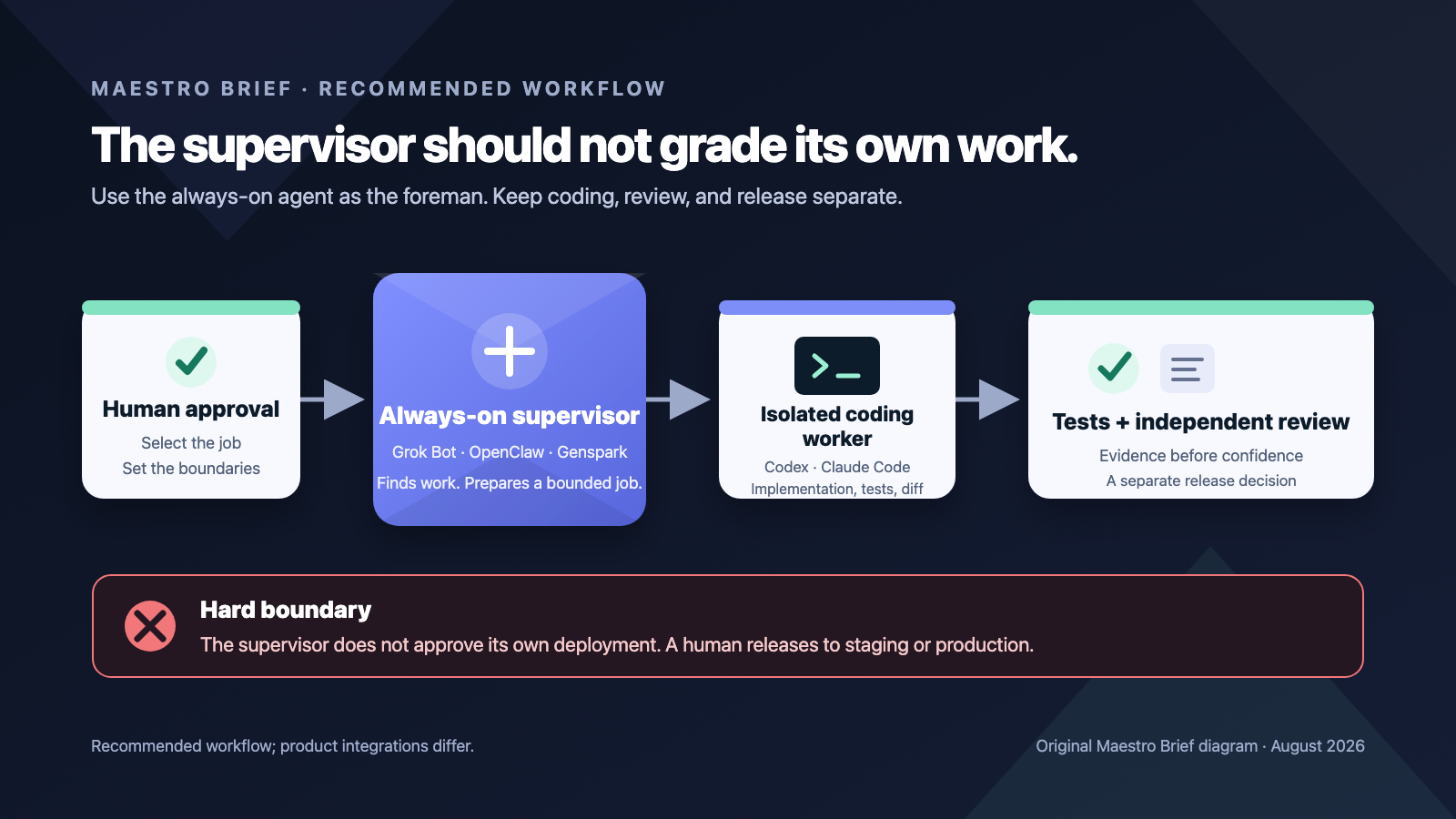
Original Maestro Brief diagram. Recommended workflow; product integrations differ. The supervisor does not approve its own deployment.
What Grok Bot actually is
Grok Bot is a managed, persistent cloud computer from xAI and Cursor. It can run named agents in parallel. Those agents can use a browser and terminal, connect to services, remember workflows, and hand work to one another.
xAI now includes it with several SuperGrok and Cursor plans. xAI announcement
The convenience is real.
So is the shared blast radius.
Every Bot in an account uses the same underlying computer. xAI says their separate screens are not security boundaries. Files, browser sessions, and command-line credentials can be shared. Deleting one Bot does not remove those shared leftovers. xAI security documentation and computer model documentation
That does not make Grok Bot reckless. It has approval controls, secret handoff, monitoring, and a managed virtual machine.
It means “managed” is not the same word as “isolated.”
Is it a more trusted OpenClaw?
Not exactly.
Grok Bot removes much of the setup burden. xAI and Cursor manage the computer, interface, updates, and some approvals. You trust their closed service and their security model.
OpenClaw is open source and self-hosted. You choose the machine, models, channels, and tools. You can inspect and change the system. You also own the patching, exposure, secrets, backups, and mistakes.
OpenClaw’s own security guide is unusually direct: one gateway assumes one trusted operator. It is not a safe boundary between hostile users. Stronger separation requires different gateways, operating-system users, or hosts. OpenClaw security guide
So OpenClaw is not the automatic safety winner.
It is the control winner.
That can become safer when a careful developer uses isolation, small permissions, and good logs. It can become much worse when somebody exposes a gateway, installs a dubious skill, and gives it the family password drawer.
What a small set of early users found
The small set of hands-on reports we reviewed likes the concept more than the current reliability.
In one hands-on report, Nate B. Jones created 12 Grok Bots in roughly eight hours. He found that named agents, one shared computer, and handoffs made multi-agent work easier to understand.
That is one enthusiastic user report, not a benchmark. Nate’s Newsletter
SentiSense reported that a Bot installed skills, performed live market research, and caught an empty API response. It also burned through its trial and found outside-tool connections immature.
SentiSense builds the market-data API used in its own test, so treat the report as useful but interested evidence. SentiSense review
Another developer described incomplete data, browser failures, and shared-login problems. A Cursor forum bug broke an approval screen; Cursor said the action failed closed and later fixed it.
These are early anecdotes, not failure rates. They show where to test before trusting the product. Developer report and Cursor forum
Maestro’s conclusion: Grok Bot has a promising interface for the supervisor job.
It has not yet earned unattended production access.
How a developer would use this every day
Overnight
The supervisor reads CI failures, monitoring alerts, GitHub issues, and support reports.
It does not fix production.
Morning
It sends a short report:
- Three failed builds.
- One likely regression.
- Two customer reports that appear related.
- The evidence and proposed next step.
A human selects one job.
Build
The supervisor prepares a bounded job for Codex or Claude Code. A human—or a supported CLI, API, or session integration—starts the coding agent in a clean workspace.
Not every supervisor supports every coding tool natively.
The task contains:
- The repository and branch.
- The exact problem.
- Relevant logs.
- Acceptance criteria.
- Required tests.
- A hard stop before deployment.
Review
The coding agent prepares the change. Tests and an independent reviewer check it.
The supervisor reports the result but does not approve its own work.
Release
A human approves staging or production. The supervisor watches the release and writes the summary.
That is boring on purpose.
Boring automation survives contact with customers.
The market in one table
| Product | Best role | Always on? | OpenClaw relationship | Main tradeoff |
|---|---|---|---|---|
| Grok Bot | Managed supervisor with named agents | Yes | Separate closed product | Easy setup; shared computer and closed platform |
| OpenClaw | Custom personal or team supervisor | Yes | The open-source reference point | Maximum control; maximum operational duty |
| Genspark Claw / GenTeam | Managed cloud computer and agent team | Yes | Separate product; can also connect external OpenClaw | Packaged agent team and model selection; credits and platform dependency |
| Hermes | Self-hosted assistant with schedules, memory, tools, and subagents | Yes | Independent alternative | Flexible models; you operate it |
| NVIDIA NemoClaw | Vendor-designed, deny-by-default reference stack around OpenClaw | Yes | Built around OpenClaw | More documented control layers; more infrastructure work |
| Manus | Persistent task and project computer | Yes | Separate product | Strong cloud workspace; less of a named-agent control plane |
| Zo | Personal cloud computer, automations, and hosted tools | Yes | Separate product | Broad personal workspace; smaller ecosystem |
| MoClaw | Managed Linux computer for an agent | Conditional | Separate product | Sleeps when idle; scheduled tasks and supported processes can keep work running |
| Claude Cowork / ChatGPT Work | Broad computer and app tasks | Task-based | Separate products | Familiar interfaces; less like a self-owned daemon |
| Claude Code / Codex | Repository coding, tests, and review | Job-based | Workers a supervisor may launch when integration supports it | Excellent builders; not the whole control plane |
Genspark deserves special attention. Its documentation presents Genspark Claw and external OpenClaw as separate backends. GenTeam adds named agents, schedules, persistent memory, and selectable models.
By contrast, xAI’s current teams documentation says Grok Bot has no model picker and users cannot restrict the model list.
That makes Genspark the closest managed competitor with more explicit model selection, not merely an OpenClaw skin. Genspark Claw documentation, GenTeam documentation, and xAI teams documentation
Hermes is the cleaner open alternative when model freedom matters. Its official documentation covers scheduled jobs, persistent memory, tools, and subagent delegation.
NVIDIA describes NemoClaw as an open reference stack with deny-by-default network, filesystem, process, gateway, and inference controls.
Those are vendor-documented design properties, not independent proof that it is safer in production. Hermes scheduling, Hermes memory, Hermes tools, and NVIDIA security guidance
Manus, Zo, and MoClaw occupy a nearby “AI computer” category.
Manus documents a persistent cloud machine that preserves files, tools, and processes. Zo packages a personal cloud computer with files, integrations, scheduled agents, and site hosting.
MoClaw provides a managed Linux computer that sleeps when idle. Its documentation says schedules or its process API can support continuing work.
They are alternatives when the computer matters more than a named team of supervisors. Manus cloud computer, Zo documentation, and MoClaw cloud-computer documentation
Claude and ChatGPT now have computer-use features with per-app permissions. They are useful for scoped work across apps. Their current official guidance still emphasizes careful permissions and bounded tasks. Anthropic computer-use guidance and OpenAI computer-use guidance
The simple security model
An always-on supervisor combines four dangerous ingredients:
- Untrusted input from email, chat, tickets, or the web.
- Persistent memory.
- Credentials.
- Tools that can change things.
One malicious webpage or support message can try to turn those ingredients against you.
The safe response is not “trust the model harder.”
Use smaller boxes.
DO
- Start read-only.
- Give each workflow its own low-privilege account.
- Keep coding work in disposable or isolated workspaces.
- Require approval before sending messages, spending money, merging code, or deploying.
- Keep logs that a human can actually read.
- Use Codex or Claude Code for bounded repository work.
- Rotate credentials when a persistent agent is retired.
DO NOT
- Give every agent the same browser profile.
- Put personal email, production cloud, banking, and source control in one session.
- Install random skills because the README has a rocket emoji.
- Let the same agent write, review, merge, and deploy.
- Treat a successful demo as proof of unattended reliability.
Which one should you choose?
Choose Grok Bot if you want the shortest path to a managed supervisor and accept its platform, plan, and shared-computer model.
Choose Genspark if you want a managed agent team with more explicit model selection.
Choose OpenClaw or Hermes if ownership, custom channels, and model freedom matter more than convenience.
Choose NVIDIA NemoClaw if its vendor-designed deny-by-default controls justify extra infrastructure work.
Use Codex or Claude Code behind any of them for serious coding when a supported CLI, API, or session integration exists.
Otherwise, let the supervisor prepare the job and have a human start the coding session.
And if all you need is one coding task, skip the supervisor entirely. Start the coding agent. Give it a clear job. Review the result.
The winning system will not be the one with the most digital employees.
It will be the one that makes responsibility impossible to lose.
What would change our mind
Grok Bot would become the clear recommendation if it adds strong per-Bot isolation, complete audit trails, predictable spend controls, model selection or restrictions, and independent evidence of reliable long-running work.
OpenClaw would become easier to recommend broadly if secure defaults make exposed gateways, shared secrets, and unsafe third-party skills much harder to create.
Until then, both are powerful supervisors.
Neither is a substitute for supervision.
Sources considered
- xAI: Grok Bot added to more plans
- xAI: Grok Bot security, approvals, and privacy
- xAI: Grok Bot computer model
- xAI: Teams and enterprise documentation
- OpenClaw security guide
- Nate’s hands-on Grok Bot report
- SentiSense hands-on Grok Bot report
- Independent developer report
- Cursor forum approval-screen report
- Genspark Claw documentation
- Genspark GenTeam documentation
- Hermes scheduling documentation
- Hermes memory documentation
- Hermes tools documentation
- NVIDIA NemoClaw security guidance
- Manus cloud-computer documentation
- Zo computer documentation
- MoClaw cloud-computer documentation
- Anthropic computer-use guidance
- OpenAI computer-use guidance
Published August 24, 2026. This is original Maestro research and analysis. The opinions and summaries are AI-generated, then independently reviewed against the linked sources.