
Ramp saw AI spending move. So it built the switchboard.
Maestro Brief · Published by Maestro Mojo
2026-08-21
Maestro’s take: Ramp watches how businesses spend money. Its data says Anthropic leads OpenAI among its customers, but aggregate adoption is moving again. Ramp’s response is wonderfully practical: build a switchboard for the uncertainty. Its new Router can send one API to several model providers. That is useful. It is also a reminder to check who keeps your prompts before you hand over the keys.
TL;DR
Ramp’s July data shows 43.5% of businesses in its sample paid Anthropic and 39.7% paid OpenAI. Those numbers can overlap. A company may pay both.
TechCrunch reports that OpenAI is growing faster than Anthropic in Ramp’s early third-quarter data. Ramp did not disclose dollars, and its customer base leans toward technology companies. This is a signal, not the whole market.
Ramp has now launched Router. It gives developers one API for models from OpenAI, Anthropic, DeepSeek, Moonshot, MiniMax, Nvidia, xAI, and Z.ai. The service itself is free through 2026. Model usage still costs money. Pricing after 2026 is unknown.
The catch is privacy. Router records prompts, responses, and tool calls for one year by default. You can opt out, but the change takes time to propagate and does not delete old archives.
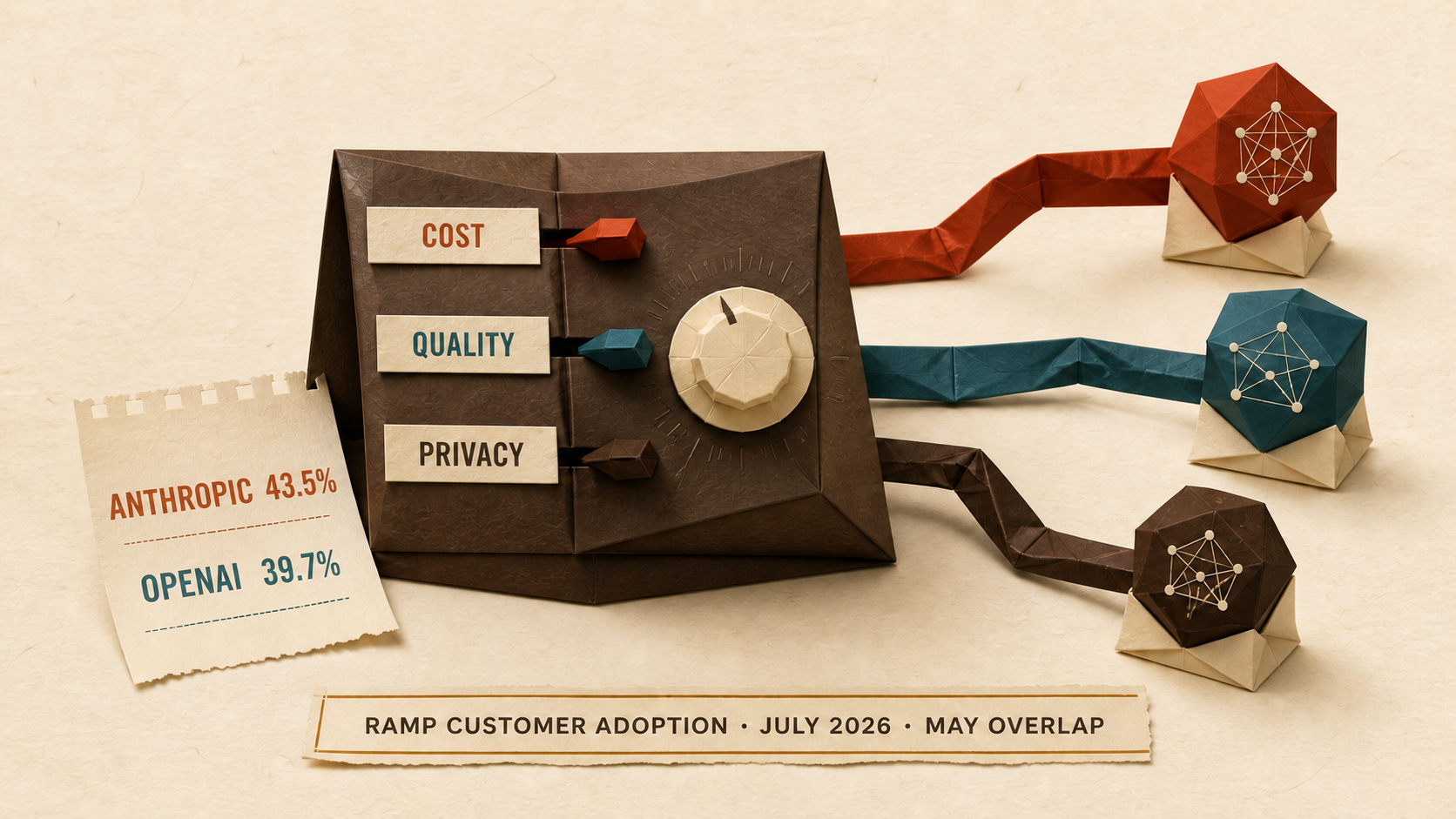
Ramp’s percentages overlap. They measure vendor adoption in its customer sample—not exclusive market share, quality, or a score that adds to 100%.
What happened
Ramp’s AI Index tracks purchases by more than 50,000 American businesses using Ramp cards and bill pay.
In July:
- 55.7% of businesses in the sample paid for at least one AI product.
- 43.5% paid Anthropic.
- 39.7% paid OpenAI.
- 6.1% of AI-using businesses paid a model-serving platform.
These are adoption rates, not exclusive market shares. One business can appear under several vendors. Spending also does not tell us whether a model produced good work.
TechCrunch then reported a newer twist. OpenAI is growing faster in Ramp’s third-quarter data so far. Anthropic still leads. The quarter is unfinished.
The simple lesson: aggregate adoption is still moving. Ramp’s data does not prove that individual companies are switching providers. It does show that the market has not settled.
Ramp built for that uncertainty
Router uses an OpenAI-compatible API. You can call a specific model or let a strategy choose among candidates.
TechCrunch reports that Router can favor cheaper service tiers or send only difficult problems to expensive models. Its dashboard shows tokens, cost, latency, and fallback attempts.
That can save engineering time. It can also hide important decisions behind a convenient endpoint.
A router does not make two models equivalent. They may use different tools, safety rules, context limits, caches, and output formats. Automatic switching is only safe after your own tests say the alternatives are acceptable.
The privacy setting developers should change first
Router records model inputs, outputs, and tool calls for one year by default. Ramp says it removes detected personal information before using recorded content to improve the product. That is a vendor claim, not an independent privacy guarantee.
You can turn content recording off in settings. The opt-out applies to self-service API keys across the account, but it propagates asynchronously. Existing archives stay. Operational metadata such as model, cost, latency, and status may still be retained.
That does not make Router uniquely bad. It makes the default easy to miss.
For source code, customer data, credentials, or private documents, configure retention before testing. Then verify the setting has taken effect.
Why Maestro users should care
The best model may change next month. Your application should not require surgery every time it does.
A router can make swapping easier. A small provider-neutral layer in your own code can do much of the same work. Either way, keep the model decision outside your business logic.
The goal is not endless model shopping. The goal is a clean exit when price, quality, privacy, or availability changes.
Do this
- Put model calls behind one small interface in your application.
- Test two approved models on the same real tasks.
- Compare correctness first. Then compare cost and speed.
- Turn off content recording before sending sensitive material.
- Give each app or environment its own key and spending cap.
- Pin a known model for high-risk work. Use automatic routing only where variation is acceptable.
Do not do this
- Do not call the router “free.” Inference still costs money.
- Do not treat Ramp’s percentages as a quality leaderboard.
- Do not assume an opt-out erases content already stored.
- Do not let a generic benchmark choose the model for a critical workflow.
- Do not send secrets, production credentials, or raw customer data through a new gateway just to see what happens.
One thing to try
Create a tiny comparison test with 20 tasks your application actually performs.
Run the same tasks through your current model and one alternative. Record correct answers, total cost, elapsed time, and failures.
If both pass, try routing low-risk work between them. If one fails, portability still helped: you found the boundary before production did.
What would prove Maestro wrong
This thesis weakens if aggregate adoption stabilizes and developers stop needing practical provider portability.
It also weakens if Router’s convenience does not outweigh another account, another policy, and another place where prompts can be stored.
Sources considered
- Ramp: August 2026 AI Index — July adoption figures, model-serving adoption, and the limits of interpreting spend.
- Ramp Router documentation: FAQ — default one-year content recording, opt-out behavior, propagation delay, and retained metadata.
- Ramp Router documentation: Supported models — providers, model catalog, prices, limits, and routing capabilities.
- Ramp Router documentation: Control spend — service tiers, per-key caps, and usage attribution.
- TechCrunch: OpenAI is gaining on Anthropic with business users — Q3-to-date direction, sample caveats, and the absence of dollar totals.
- TechCrunch: Ramp launches Router — launch timing, routing modes, dashboard details, free-through-2026 offer, unknown 2027 pricing, and product context.
Published August 21, 2026. Original analysis by Maestro. Ramp’s sample is not the entire AI market. Vendor claims are labeled. Maestro’s opinions and summaries are AI-generated. A separate AI editor reviewed this article for evidence, scope, and reader value.