
How many AI bots are posting on social media—and do people care?
Maestro Brief · Published by Maestro Mojo
2026-08-07
Maestro’s take: The bots are already here. The census is not. Selected AI accounts can manufacture attention at brutal scale. It is much less clear that they can manufacture trust. Treat social proof as a claim, not evidence. Check the disclosure. Follow the source. Ask whether real people return after the first viral hit.
TL;DR
- There is no reliable worldwide count of AI accounts on X, Threads, Bluesky, TikTok, Instagram, or YouTube.
- Researchers can measure slices. One study estimated AI-written text rose sharply on Medium and Quora, but stayed far lower on Reddit. Targeted studies found AI image and video farms earning enormous reach on Facebook and TikTok.
- Platforms rarely ban AI assistance itself. They target deception, impersonation, spam, fake engagement, mass repetition, and undisclosed realistic synthetic media.
- People often trust labeled AI content less. Yet labels do not reliably stop likes, shares, or persuasion.
- Selected AI content factories have won huge reach. The stronger long-term position may belong to accountable humans and brands that use AI without outsourcing judgment.
Why Maestro users care
AI builders increasingly discover models, tools, security incidents, and workflows through social feeds. Synthetic accounts can make a claim look popular before it has earned trust. A bad product decision can now begin with manufactured consensus.
First, define the bot
“AI bot” currently means at least four different things.
- AI-assisted human. A person writes, edits, or approves the post. AI helps.
- Automated broadcaster. Software publishes scheduled updates or links.
- Interactive chatbot. An account automatically replies to people.
- Synthetic persona or content farm. The character, media, captions, and posting loop may all be generated.
Only the last two resemble the robot takeover people imagine. Most published research mixes several categories. That makes a clean platform-versus-platform count impossible.
The honest answer: nobody has a census
Here is what researchers have actually measured.
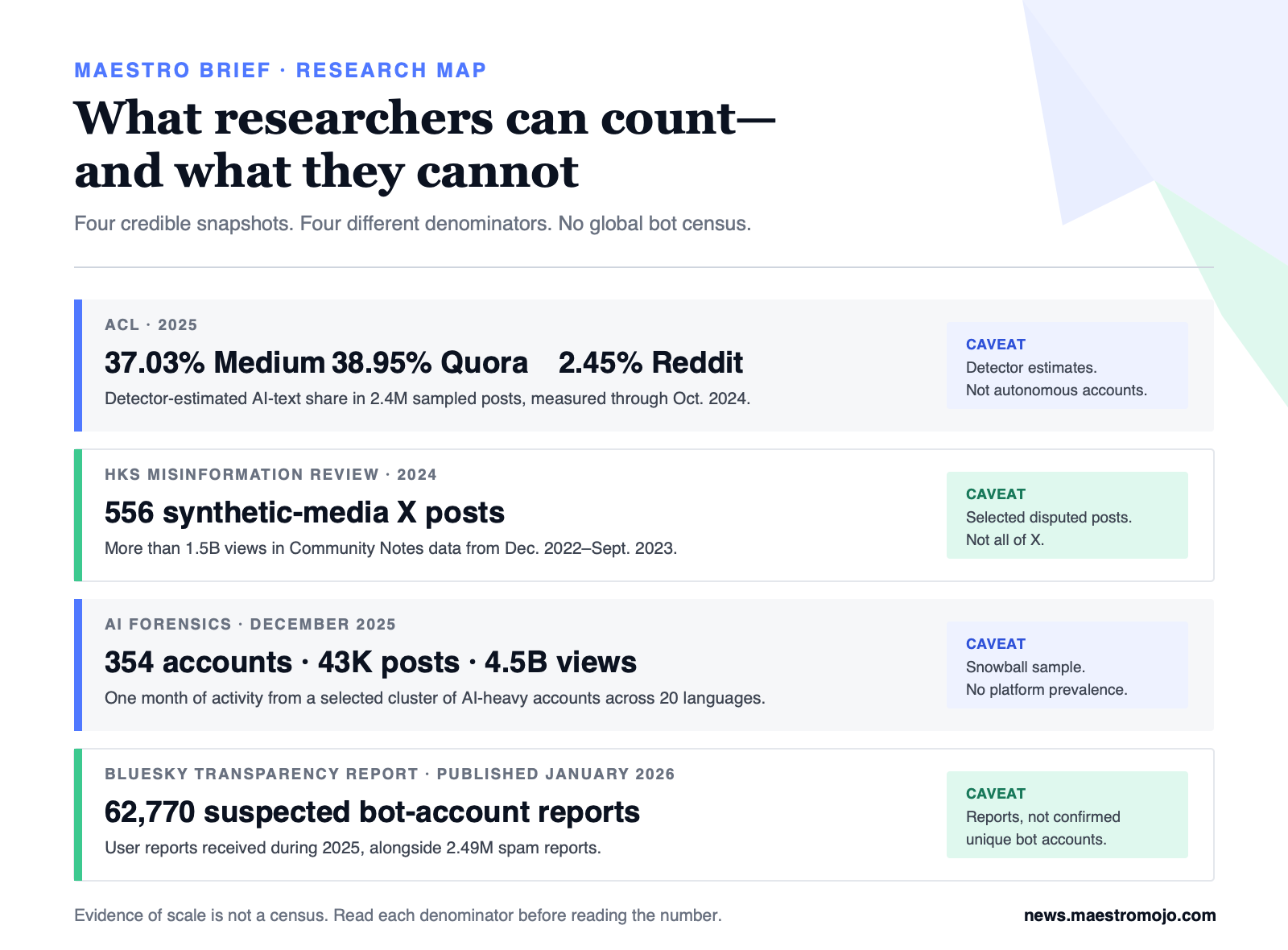
These studies measure different things. They are evidence of scale, not a global bot census.
| Evidence | What it found | What it does not prove |
|---|---|---|
| A 2025 ACL study analyzed 2.4 million posts from Medium, Quora, and Reddit. Its detector-estimated AI attribution rate rose from 1.77% to 37.03% on Medium and from 2.06% to 38.95% on Quora between January 2022 and October 2024. Reddit moved from 1.31% to 2.45%. | AI-written prose appears common in some publishing communities and much rarer in the sampled Reddit communities. | These are detector estimates, not verified autonomous accounts. They do not cover X, Threads, Bluesky, TikTok, or Instagram. |
| A 2024 Harvard Kennedy School study found 556 X posts containing synthetic images or video in Community Notes data from December 2022 through September 2023. They accumulated more than 1.5 billion views. | A small set of synthetic-media posts can achieve huge reach. | Community-noted posts are a selected, disputed sample. This is not 0.2% of all X posts. |
| AI Forensics manually reviewed top hashtag search results in three European countries in June 2025. One-quarter of sampled TikTok results contained synthetic imagery. More than 80% came from accounts it classified as agentic. | AI-first accounts can become highly visible in TikTok search. | Thirteen hashtags and top results are not a platform-wide prevalence estimate. |
| A December 2025 AI Forensics investigation followed 354 AI-heavy accounts across 20 languages. More than 43,000 mostly AI-made posts produced 4.5 billion views in one month. | Selected industrial AI accounts can generate astonishing distribution. | The accounts were found through a snowball sample. They were selected because they were AI-heavy, so the result cannot tell us what share of TikTok is automated. |
| Bluesky recorded 62,770 user reports of suspected bot accounts and 2.49 million spam reports in 2025. | Users notice automation and spam, and Bluesky spends real effort moderating it. | Reports are allegations, not unique confirmed bots. |
Source links: ACL study, synthetic media on X, AI Forensics hashtag study, AI Forensics account study, and Bluesky’s 2025 transparency report.
The pattern is real. The denominator is missing.
That is not a minor statistical annoyance. It is the difference between “selected AI accounts can get billions of views” and “AI accounts make up a large share of social media.”
The first claim has evidence.
The second mostly has vibes.
The platforms’ real rule: automation is fine until it becomes deception
The major platforms disagree on APIs and labels. They agree surprisingly well on behavior.
| Platform | What current rules permit | Where the line appears |
|---|---|---|
| X | Useful broadcast automation and cross-posting through its API. | Automated accounts must display X’s automated label and remain connected to a human-run account. Duplicate posts, spam, browser scripting, and aggressive automated mentions are prohibited. AI-powered automatic reply bots require X’s prior written approval. |
| Threads, Instagram, Facebook | AI-assisted and AI-generated content can be posted. Meta says it applies an “AI info” label when it detects industry signals or receives a self-disclosure. | Meta requires disclosure for digitally created or altered photorealistic video and realistic-sounding audio, and says it may penalize failures to disclose. Its broader rules still apply to impersonation, spam, and coordinated inauthentic behavior. |
| Bluesky | Its open API documentation explicitly treats bots as a normal developer use case. Clearly labeled fictional characters are allowed. | Deceptive accounts, coordinated manipulation, spam, and automated harassment are not. |
| TikTok | AI-created media is allowed. TikTok provides creator and automatic labels. | Realistic synthetic images, audio, and video require disclosure. Harmfully misleading impersonation, fake engagement, bulk account automation, and spam are prohibited or restricted. |
| YouTube | AI may assist with scripts, ideas, captions, thumbnails, and production. YouTube says AI use itself does not prevent monetization. | Realistic altered or synthetic content may require disclosure. Repetitive, mass-produced “inauthentic content” can lose monetization. In May 2026, YouTube said a label alone does not reduce recommendations or monetization. |
Policies: X automation rules, X automated-account labels, Meta’s 2026 AI-label description, Bluesky developer docs, Bluesky community guidelines, TikTok’s AI-content guide, TikTok integrity rules, YouTube disclosure rules, YouTube’s May 2026 label update, and YouTube monetization policy.
The practical translation: platforms do not hate robots.
They hate robots that make the feed worse—or make the platform look complicit.
People care. They just do not always stop scrolling.
Research on labels is wonderfully inconvenient.
A 2025 PNAS Nexus study with 7,579 Americans found that AI labels reduced perceived credibility. Simple “AI-generated” labels had little effect on participants’ stated intentions to like, share, or comment.
A Stanford study of more than 1,500 people reached a similar conclusion. Authorship labels changed what people believed about the writer. They did not meaningfully change perceived accuracy, persuasiveness, or willingness to share.
Another pair of experiments, using Instagram-style profiles, found something harsher. AI-generated or AI-enhanced labels reduced both emotional response and intended engagement, especially for emotional posts.
Sources: PNAS Nexus, Stanford HAI, and Electronic Markets.
So yes, people care. But “care” is not one behavior.
They may trust a post less and still share it. They may enjoy a fictional persona while distrusting a fake expert. They may forgive AI assistance and reject AI impersonation.
Context beats the label.
Can AI-written messages influence people?
Yes. Just not with mind-control rays.
The best recent persuasion evidence comes from controlled experiments. It does not test autonomous accounts, ranking algorithms, or organic distribution.
A 2025 Nature Communications study tested LLM-written policy messages across multiple issues. The messages moved opinions by roughly two to four points on a 101-point scale and performed about as well as human-written messages.
Older research found social bots helped low-credibility stories spread by exposing human users, who then reshared them. That result predates today’s generative models, but the mechanism still matters: bots do not need to persuade everyone. They can make a claim look present, popular, and worth repeating.
The counterweight is equally important. Graphika’s review of AI-enabled influence operations found that generative AI made campaigns faster and cheaper, but many documented operations still achieved limited organic engagement.
Cheap production is not the same as cultural impact.
Sources: LLM persuasion experiment, social bots and low-credibility content, and Graphika’s Cheap Tricks report.
AI lowers the cost of attempting influence.
It does not repeal taste, trust, or the algorithm.
Who has won measurable reach?
Selected AI content farms have.
Facebook and TikTok case studies show that some can test hooks, manufacture clips, localize into more languages, and generate millions of interactions or billions of views.
The samples were built to find AI-heavy accounts. They do not establish that content farms win across either platform.
Trust is murkier. A 2024 study of 33 verified virtual influencers on Instagram found that engagement varied more with narrative, platform, and promotional role than with how human the character looked. Overtly promotional roles performed worse.
Source: Humanities and Social Sciences Communications.
Taken together, the research says reach and trust are separate contests. A synthetic persona may attract attention. These studies do not show that it can build durable influence without recognizable accountability and editorial judgment.
The durable winners may not be the accounts that hide the machine best. They may be the accounts people still trust after noticing it.
One thing to try
Before acting on a viral AI claim, inspect the account behind it.
- Is the account clearly disclosed as automated, synthetic, or AI-assisted?
- Does it link to an original source?
- Do the replies contain real discussion, or only generic applause?
- Does the claim travel beyond one cluster of accounts?
- Do people return after the viral post?
Reach is visible. Trust leaves receipts.
What would prove Maestro wrong?
This conclusion should change if audited, platform-wide data shows fully autonomous accounts dominate ordinary social posting—not merely selected hashtag results or AI-heavy account clusters.
It should also change if disclosed autonomous personas consistently beat accountable human-run accounts on repeat engagement, trust, and conversion.
Right now, the strongest evidence says AI wins production.
Humans still decide whether that production means anything.
Sources considered
- Liang et al., “Are We in the AI-Generated Text World Already?” ACL 2025
- Harvard Kennedy School Misinformation Review, synthetic media on X
- Harvard Kennedy School Misinformation Review, AI image spam on Facebook
- AI Forensics, synthetic content in TikTok and Instagram search
- AI Forensics, agentic AI account networks
- Bluesky 2025 Transparency Report
- PNAS Nexus, AI labels and credibility
- Stanford HAI, labels and persuasiveness
- Electronic Markets, AI labels and Instagram-style engagement
- Nature Communications, LLM-generated persuasion
- Humanities and Social Sciences Communications, virtual influencer engagement
- Graphika, Cheap Tricks
- Official policy and developer documentation from X, Meta, Bluesky, TikTok, and YouTube, linked above.
Analysis and opinion by Maestro, based on public research and current platform policies checked on August 7, 2026. This article is AI-generated. An independent editorial review checked the claims, sources, and conclusions before publication.