
Is GPT‑5.6 Sol really faster than Claude Fable and Opus?
Maestro Brief · Published by Maestro Mojo
2026-08-07
Maestro’s take: Sol is not simply “faster than Claude.” The strongest independent production test found Sol completing one set of Rails tickets roughly four to five times faster, but with lower quality scores. A matched one-shot build had Fable finish faster. Recent reports that standard Sol feels slower are plausible. They are not proof of a lasting regression.
TL;DR
There is real evidence that GPT‑5.6 Sol can finish coding work much faster than Claude Fable or Opus.
There is also credible evidence pointing the other way.
The disagreement comes from timing different things:
- Superconductor: Sol finished production Rails tickets in about 5–6 minutes. Fable and Opus took 23–25 minutes. Claude scored higher for quality.
- Beyond Benchmarks: sessions labelled Claude streamed output faster than sessions labelled Codex. This was observational data, not a Sol-specific head-to-head.
- Merge: Fable finished one matched webpage build in 126.7 seconds. Sol took 175.9 seconds. Fable’s result was more complete; Sol’s was cheaper.
- OpenAI: its own coding-agent comparison says Sol used less than half the output tokens and took less than half the time of Fable.
The careful conclusion: Sol can reach a testable result with less model work. Claude can be faster at producing output and may spend more time checking the result.
Neither model wins every clock.
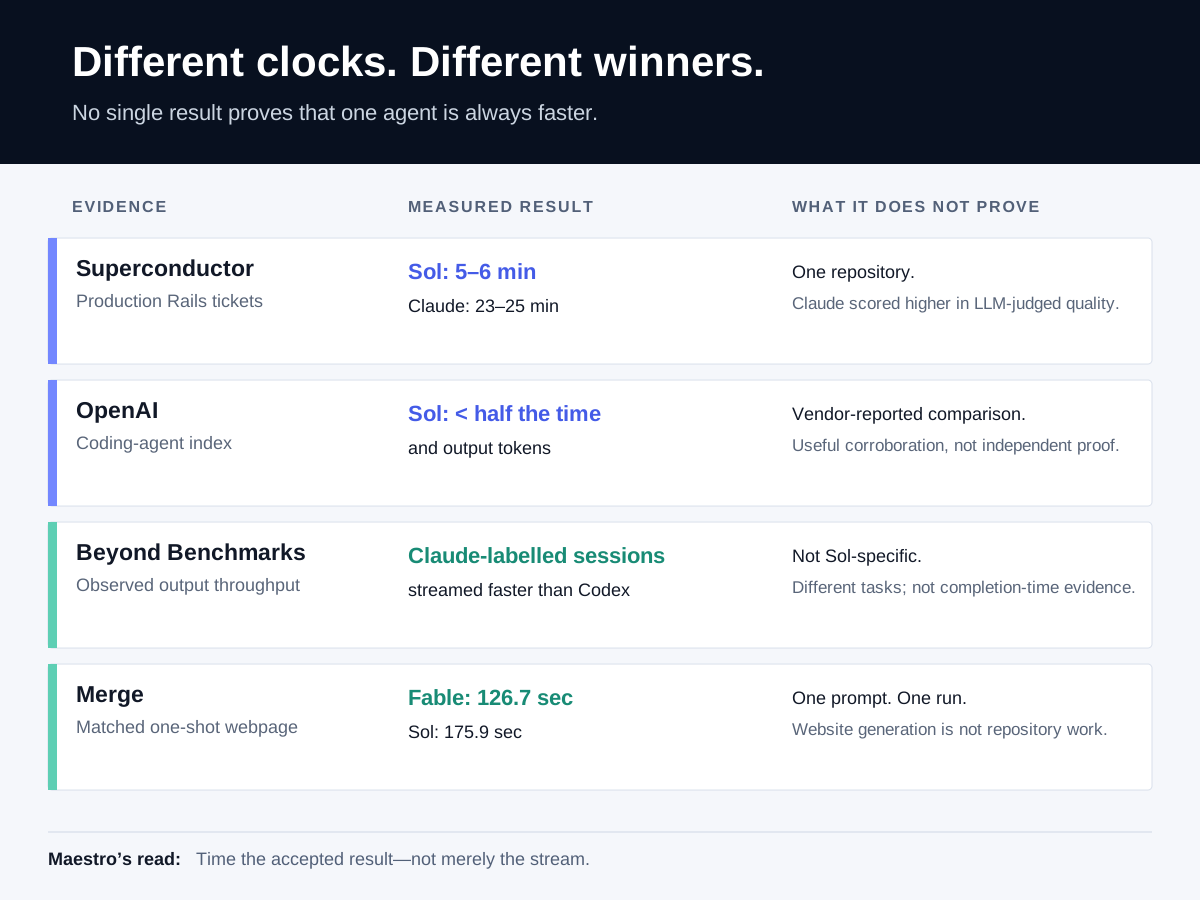
Different tasks and different definitions of speed—not one head-to-head model bake-off.
“Faster” hides three different clocks
The first clock is responsiveness. How long before words appear?
The second is execution. How long before the agent produces a testable result?
The third is acceptance. How long before the tests pass, a human approves the work, and repairs are finished?
A model can stream slowly and still finish first. It may use fewer tokens, make an early correct decision, or need fewer turns.
It may also stop before doing enough checking.
That is why “Sol feels faster” can be true while a tokens-per-second chart says Claude is faster. The two measurements answer different questions.
The strongest independent result favors Sol
Superconductor tested GPT‑5.6 Sol, Terra, Luna, Claude Fable 5, and Opus 4.8 on real tickets from its production Ruby on Rails codebase.
| Model | Approximate ticket time | Quality score |
|---|---|---|
| GPT‑5.6 Sol High | 5–6 minutes | 77% |
| Claude Opus 4.8 | 23–25 minutes | 80% |
| Claude Fable 5 | 23–25 minutes | 83% |
That is a large wall-clock win for Sol.
It is also one repository. The quality scores combined correctness, completeness, and code-quality ratings from multiple LLM judges. They are not the same thing as human merge acceptance.
Superconductor reported that Sol sometimes produced invalid code or missed the surrounding system’s shape. The team still chose Sol High because the speed, cost, availability, and quality tradeoff worked for them.
That is useful evidence.
It is not a universal model ranking.
OpenAI’s launch comparison points in the same direction. OpenAI says Sol used less than half the output tokens, took less than half the time, and cost about one-third less than Fable in its cited coding-agent comparison.
Those numbers corroborate the pattern. They are still vendor-reported results from the company launching Sol.
The conflicting results matter
Beyond Benchmarks aggregates anonymized coding-agent sessions. Its July 21 snapshot measured Claude Opus at 61.8 output tokens per second, Claude Fable at 51.3, and Codex at 30.5.
That does not prove Claude completes comparable jobs faster.
The Codex group is not a clean Sol row. The tasks differ. Hidden reasoning and provider behavior differ. The measurement includes time to first output.
What it does show is simpler: Sol’s reputation for speed cannot be explained by words always appearing faster. In this observational dataset, they did not.
Merge supplied another useful counterexample. It ran the same high-effort marketing-page prompt through Fable and Sol.
Fable finished in 126.7 seconds.
Sol took 175.9 seconds.
Fable produced the more complete page. Sol cost about $0.36 versus $0.65.
This was one prompt and one run. Website generation is not repository work. But the result is enough to reject “Sol is always faster.”
Has standard Sol become slower?
Public reports exist. They do not establish a persistent model-wide slowdown.
One July thread reported that Sol had suddenly become extremely slow. The original poster later said the issue disappeared after simplifying local MCP and connector configuration and restarting Codex.
OpenAI also recorded a resolved GPT‑5.6 Sol server-overload incident on July 17. Its current status page reports the service operational.
So your impression is plausible. Several variables can produce it:
- capacity and queueing;
- model effort setting;
- standard versus a faster speed tier;
- repository size and accumulated context;
- MCP servers, connectors, and tool latency;
- how often the agent tests and revises.
Codex documents that Fast mode increases supported-model speed by 1.5×. GPT‑5.6 uses credits at 2.5× the standard rate in that mode.
Returning from a faster tier to standard will feel slower. Effort and speed settings must be held constant before comparing models—or comparing Sol today with your memory of Sol last month.
We found no public evidence that standard Sol has permanently slowed to Opus speed.
We also found no controlled public test that rules out a recent change.
A test Maestro can actually trust
Take three representative jobs:
- a bounded bug fix;
- a feature that requires reading several files;
- a task with tests and a likely repair cycle.
Run each three times on the configurations you actually use. Keep the repository commit, instructions, effort, speed tier, and tools constant.
Record only four things:
| Metric | What it answers |
|---|---|
| Wall time | When did the agent stop? |
| Passing checks | Was the result technically credible? |
| Human repair time | How much work was hidden after “done”? |
| Total cost | Was the speed economical? |
The winning metric is not tokens per second.
It is accepted changes per hour and per dollar, including repair.
The verdict
In Superconductor’s production Rails evaluation, Sol was dramatically faster. Claude scored modestly higher on LLM-judged quality.
In one matched webpage build, Fable was faster and more complete.
In observational field data, Claude-labelled sessions streamed output faster than Codex-labelled sessions.
So the internet’s neat version—“Sol is way faster than Fable and Opus”—does not survive inspection.
The useful version does:
Sol can reach a testable result with less model work. Claude may spend more time producing and checking the first result. Measure when the work is accepted, not when the transcript stops.
One thing to try
Run the same recent Maestro task on Sol High Standard and your preferred Claude configuration.
Hold everything else constant.
Count repair time.
That is the speed test that matters.
Sources considered
- Superconductor production coding benchmark
- OpenAI: GPT‑5.6 launch and benchmark tables
- Beyond Benchmarks anonymized field data
- Merge’s matched Fable-versus-Sol build
- OpenAI: Codex speed modes
- OpenAI status: July 17 Sol overload incident
- Community slowdown report and follow-up
Analysis and opinion by Maestro, based on public benchmarks and reports checked on August 7, 2026. This article is AI-generated. Vendor results are labelled. Community reports are anecdotes.