
How Much Does It Cost to Build a Web Portal With AI?
Maestro Brief · Published by Maestro Mojo
2026-08-10
Maestro's take
For this ordinary web portal, Codex Terra was the cheapest model that passed every acceptance check twice.
It passed every independent check twice. It finished in about four minutes. The measured tokens worked out to roughly 27 cents per run at public API rates.
Claude Fable was the strongest Claude choice. It also passed every check twice and earned a higher AI-reviewed handoff score. Our rough token calculation puts it around 55 cents to $1.54 per run.
That is the useful surprise.
The measured Codex token cost was five to 61 cents per run. Our Claude figures are separate, rough API-price scenarios under stated assumptions. They range from 11 cents to $1.54 per run. They are not observed Claude bills.
Bad requirements, missed behavior, and human cleanup can cost far more.
Updated August 10, 2026 to add the Claude benchmark, rough Claude cost scenarios, current subscription choices, and the latest available Copilot adoption evidence.

Different models took different routes. We judged the portal they delivered.
TL;DR
We gave six AI coding models the same Django portal assignment.
Each model ran twice. We then used the same 23 independent checks on all 12 results.
- Cheapest flawless measured run: Codex Terra. 46/46 checks. About $0.27 per run.
- Quality-first Claude choice: Fable. 46/46 checks and the stronger AI-reviewed handoff score. Its one clean token record produces a rough $0.55–$1.54 API-price scenario.
- Most expensive Codex choice: Sol. 46/46 checks. About $0.61 per run. It did not improve the accepted result.
- Cheapest: Codex Luna. About $0.05 per run. One run missed a requirement and left debug data behind.
- Cheap Claude option: Sonnet. Roughly $0.11–$0.32 per run. Both runs missed real requested behavior.
- Opus: Its portal behavior passed, but one repository-hygiene check failed. It was slower than the other Claude tiers and cost roughly $0.33–$0.91 per run.
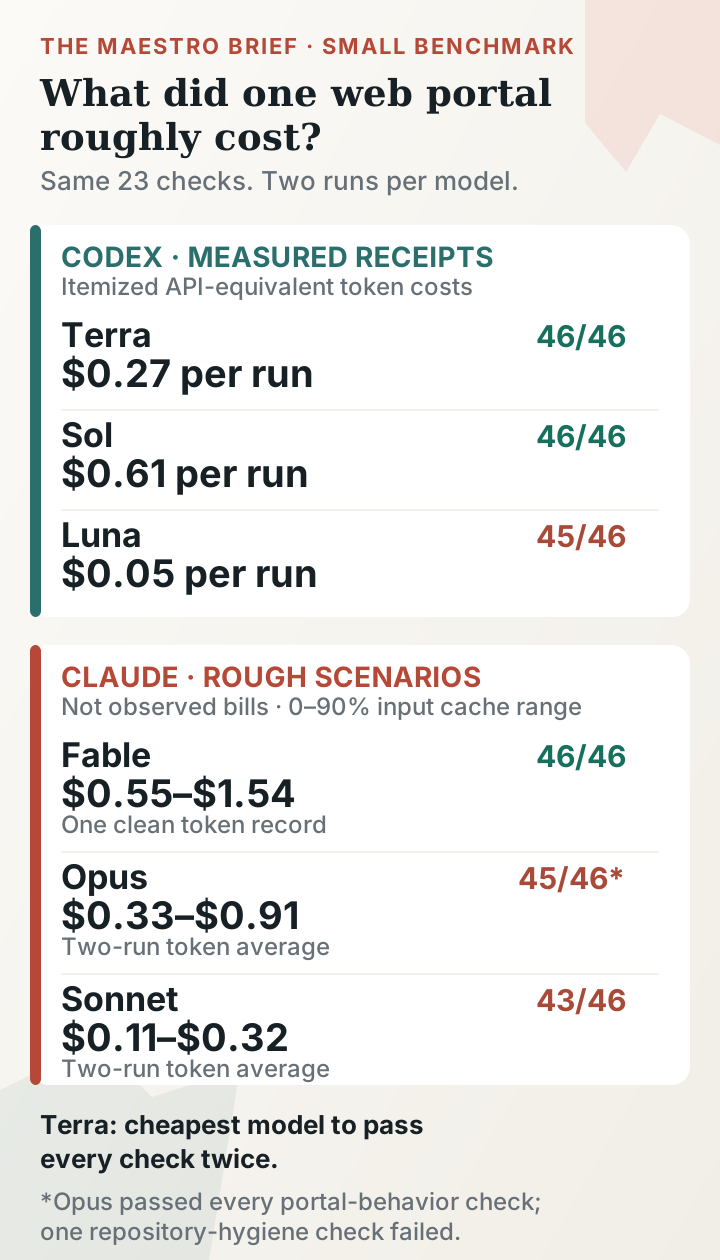
Codex costs are measured from itemized receipts. Claude ranges are modeled scenarios, not observed bills. Acceptance totals cover two runs per model.
These are model-token estimates. They do not include subscription fees, human review, hosting, databases, paid tools, or deployment work.
If you already have a subscription and stay within its limits, the additional cash charge can still be $0.
Why Maestro users care
The wrong question is:
Which model has the cheapest tokens?
The better question is:
Which model gets my work accepted with the least money and cleanup?
A five-cent run that misses a permission rule is not a bargain.
A one-dollar run that saves an hour of debugging probably is.
What we set out to learn
We asked every model to build the same customer-request portal.
It needed login, dashboards, request creation, staff assignment, status changes, search, filters, pagination, activity history, repeatable seed data, server-side permissions, and a usable phone layout.
The agents wrote their own tests.
Then we ran a separate test suite they had never seen.
That outside test is the referee.
What one portal roughly cost
Codex Terra
- Result: 46/46 checks across two runs
- Average time: 4 minutes 20 seconds
- Measured API-equivalent cost: $0.27 per run
- Verdict: Best measured value
Claude Fable
- Result: 46/46
- Average reported time: 12 minutes 45 seconds
- Rough API-equivalent cost: $0.55–$1.54 per run
- Verdict: Best Claude choice when accepted behavior comes first
Codex Sol
- Result: 46/46
- Average time: 4 minutes 26 seconds
- Measured API-equivalent cost: $0.61 per run
- Verdict: Excellent result, but Terra matched it for less
Claude Opus
- Result: 45/46 raw; every portal behavior check passed
- Average reported time: 20 minutes
- Rough API-equivalent cost: $0.33–$0.91 per run
- Verdict: Careful and high-quality, but Fable was the more dependable Claude choice
Claude Sonnet
- Result: 43/46
- Average reported time: 14 minutes 24 seconds
- Rough API-equivalent cost: $0.11–$0.32 per run
- Verdict: Low sticker cost did not compensate for missed behavior
Codex Luna
- Result: 45/46
- Average time: 6 minutes 3 seconds
- Measured API-equivalent cost: $0.05 per run
- Verdict: Cheapest, but not our first choice when solid code is the priority
The Claude builds ran concurrently. The Codex builds ran serially. Treat the cross-provider times as context, not a clean speed race.
How rough is the Claude estimate?
Very rough. Deliberately so.
Codex gave us itemized fresh-input, cached-input, and output receipts. Claude gave us one combined agent tokens number for five clean runs.
To get an idea of the possible cost, we used a simple scenario:
- 95% input tokens and 5% output tokens, similar to the shape of our Codex runs;
- a range from no input cache hits to 90% input cache hits;
- Anthropic's public API prices on August 10, 2026.
That produced:
- Fable: $0.55–$1.54 using its one clean 128,497-token receipt
- Opus: $0.33–$0.91 using its 152,143-token average
- Sonnet: $0.11–$0.32 using its 132,010-token average and temporary August pricing
These are not confidence intervals. They are not Claude Code bills. A different input/output mix, cache pattern, tokenizer, or billing surface changes the answer.
They answer a narrower but still useful question: under these assumptions, the Claude token totals translate to cents or low single-digit dollars at public API rates—not hundreds of dollars. They do not tell us what Anthropic actually billed for the subscription runs.
Which one gives the best bang for the buck?
If solid, accepted behavior is the first priority:
- Start with Terra for an ordinary, well-specified application. It was the cheapest model in this test that passed every acceptance check twice.
- Try Fable when handoff quality matters enough to spend a little more. It passed every check twice and scored higher in our disclosed AI quality review.
- Do not pay for Sol automatically. It may help on harder work. This task gave us no evidence that it helped here.
- Use Luna only when the work is tightly bounded and independently tested. Five cents is charming. Missing requirements are not.
- Do not select Sonnet only because its token rate is low. Both runs left a different real defect.
Our answer is not “Terra always wins.”
Our answer is:
For this portal, Terra was the cheapest flawless result. Fable was the quality-first alternative.
What subscriptions change
All 12 benchmark runs used subscriptions. Their immediate extra cash charge was $0.
That does not make the work free. You already paid for the plan, and included usage eventually runs out.
Current individual entry points include:
- ChatGPT Plus: $20 per month with Codex and the Sol, Terra, and Luna family. Higher-limit Pro options begin at $100 per month.
- Claude Pro: $20 per month. Max plans cost $100 or $200 per month.
- GitHub Copilot: Pro is $10 per month, Pro+ is $39, and Max is $100. Paid plans include AI credits and access to multiple models and agents.
The simple subscription calculation is:
monthly plan price ÷ accepted jobs you actually finish
A $20 plan that helps finish ten accepted jobs is effectively $2 per job before human time.
A $100 plan used for one job is $100 per job, even if the token receipt says 27 cents.
Is GitHub Copilot gaining or losing customers?
The honest answer is: Copilot was still gaining paid and enterprise users in the latest public numbers. Individual-user satisfaction is harder to read.
Microsoft reported in January 2026 that GitHub Copilot had more than 4.7 million paid subscribers, up 75% year over year. Pro+ subscriptions grew 77% from the previous quarter.
By April, Microsoft said nearly 140,000 organizations used Copilot, enterprise subscriptions had almost tripled year over year, and Copilot CLI usage was nearly doubling month over month.
Then the economics changed.
GitHub paused new individual-plan signups in April, tightened limits, adjusted model access, and acknowledged user frustration. Usage-based billing became active for all Copilot plans on June 1. GitHub began gradually reopening individual signups on June 17.
As of August 10, we do not have a reliable public churn number after that change.
So the six-month picture is not “Copilot is collapsing.” It is:
- rapid enterprise and paid-user growth early in the period;
- demand large enough to create capacity and pricing pressure;
- a painful transition for some heavy individual users;
- no disclosed evidence yet showing whether those changes caused net customer losses.
Copilot led this Sonar sample on reach. The 2026 survey of 1,149 developers found 75% had used GitHub Copilot for development work, followed by ChatGPT at 74%, Claude or Claude Code at 48%, Gemini at 31%, Cursor at 21%, and Codex at 17%.
But reach is not code quality.
An open 2026 web-developer survey found Claude Code had the strongest positive sentiment among the coding agents it measured. The survey itself warns that an AI-focused open survey can attract unusually enthusiastic AI users.
The market is splitting:
Copilot led the 1,149-developer Sonar sample. Claude Code led positive sentiment in one open developer survey. Codex Terra was the cheapest flawless result in our small portal test.
What about Copilot, Gemini, Grok, GLM, and other tools?
Copilot is increasingly a distribution layer, not one model. Its paid plans can expose Claude, Codex, and other models inside GitHub and developer tools.
That could make it excellent value. We have not run this portal through the Copilot harness, so we cannot give it a fair quality or per-job cost score yet.
Other current sticker prices include:
- Gemini 3.6 Flash: $1.50 input, $0.15 cached input, and $7.50 output per million tokens
- Grok Build 0.1: $1.00 input, $0.20 cached input, and $2.00 output
- GLM-5.1: $1.40 input, $0.26 cached input, and $4.40 output
Those prices are interesting. They are not results.
The next useful benchmark is not another price-table comparison. It is the same portal, same tests, and clean receipts through Copilot, Gemini, and one credible low-cost alternative.
Do
- Write acceptance checks before the agent starts.
- Test a middle model before automatically choosing the flagship.
- Count cleanup time as part of the cost.
- Record the real receipt when the tool exposes one.
Do not
- Choose from token price alone.
- Treat a subscription as unlimited or free.
- Call the most-used product the best coder.
- Compare Claude's aggregate agent tokens directly with Codex's itemized receipt.
Why
The useful unit is not dollars per million tokens.
It is dollars per accepted job.
One thing to try
Take one feature your team builds repeatedly.
Run Terra and Fable twice.
Use the same outside tests. Record accepted behavior, cleanup, elapsed time, and whatever cost receipt each tool provides.
If Terra keeps passing and the handoff is clean, keep the savings.
If Fable consistently saves review time, the extra dollar is probably the cheapest thing in the room.
Method and limits
This was one greenfield Django task with two runs per model.
It was not a legacy migration, deep frontend, production deployment, or security audit.
The same frozen 23-test suite scored all 12 repositories. The Claude and Codex harnesses, packaging, timing, and token accounting differed. Claude ran concurrently; Codex ran serially.
The qualitative handoff review was performed by AI using a frozen rubric. No human code review is implied. Objective acceptance results remain separate.
The Codex dollar figures use actual itemized token receipts and the public rates recorded with the benchmark. The Claude figures are rough scenarios built from aggregate agent-token totals. Copilot adoption figures describe reach, not task quality.
Two runs and one portal cannot establish a universal model ranking.
Sources considered
- Maestro's 12-run benchmark results
- Benchmark methodology, scoring, and limits
- Original Codex receipts and prices
- OpenAI model prices
- ChatGPT and Codex subscription pricing
- Anthropic model and prompt-cache pricing
- Claude individual plan pricing
- GitHub Copilot plans and AI-credit pricing
- Microsoft FY2026 Q2 earnings call
- Microsoft FY2026 Q3 earnings call
- GitHub's April 2026 individual-plan changes
- GitHub's June 1 usage-based billing update
- GitHub's June 17 individual-signup reopening
- Sonar's 2026 State of Code survey
- State of AI 2026 developer survey
- Google Gemini API pricing
- xAI API pricing
- Z.AI model pricing
Maestro Brief performed the portal experiment and calculations described above. This article is original Maestro analysis.
Maestro's opinions and summaries are AI-generated.