
The AI Presence Race: Who Gets to Live in Your Room?
Maestro Brief · Published by Maestro Mojo
2026-08-10
Maestro’s take.
The OpenAI puck may be real.
The details are not official.
That distinction matters.
Bloomberg’s July reporting, also summarized by TechCrunch, describes a portable, screenless ChatGPT companion with mechanical elements that can move. Bloomberg later reported a doughnut-like, hockey-puck-sized design with cameras, microphones and speakers, according to TechRadar’s summary. That later report put the possible price at $300–$400. Separate Bloomberg reporting summarized by Forbes placed the intended release in 2027, with the timing subject to change.
OpenAI has not officially announced those specifications, a price or a release date.
So let us skip pretending we have reviewed a product that does not yet exist.
The interesting question is larger.
Why does OpenAI want an object in your room?
Maestro’s read: the next AI war is not just about which model gives the smartest answer.
It is about which company gets permission to be physically present—to sense, remember, recommend and act.
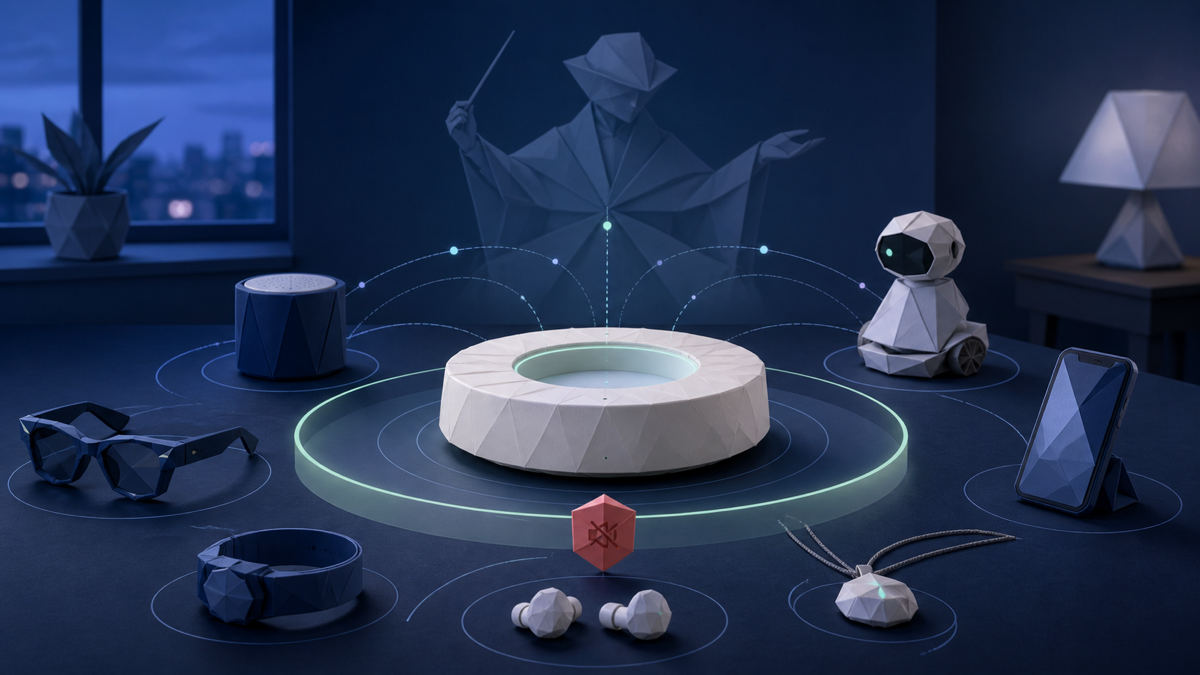
Original Maestro Brief illustration: the hardware is only the surface. The real competition is over context and permission.
TL;DR
If the reporting is accurate, OpenAI would not be inventing the AI speaker.
It would be joining a race already being run by Meta, Amazon, Google, Apple and others.
The winner will not have the cutest personality.
It will remove enough friction to beat the phone. It will remember useful context. It will complete real tasks. And it will establish privacy boundaries people can understand without reading a policy written by twelve attorneys.
That is a much harder product than a ChatGPT speaker with charming lights.
Published: August 10, 2026.
Why Maestro users should care
Developers are building the services these assistants will call.
The important platform may not be the puck itself. It may be the permission, identity, memory and audit system behind it.
The interface can be charming.
The control plane cannot be vague.
This is a presence race
Today, using an AI often means stopping what you are doing.
You reach for a device. Unlock it. Open an app. Start a conversation. Explain what is happening.
A presence device tries to remove that ceremony.
It is available where life happens. With the right permission and context, it can help before the moment passes.
Always available does not automatically mean always recording. Recording does not automatically mean uploading. Uploading does not automatically mean retaining.
Those are separate product decisions. Buyers should be able to see and control every one.
But different devices occupy very different positions in your life.
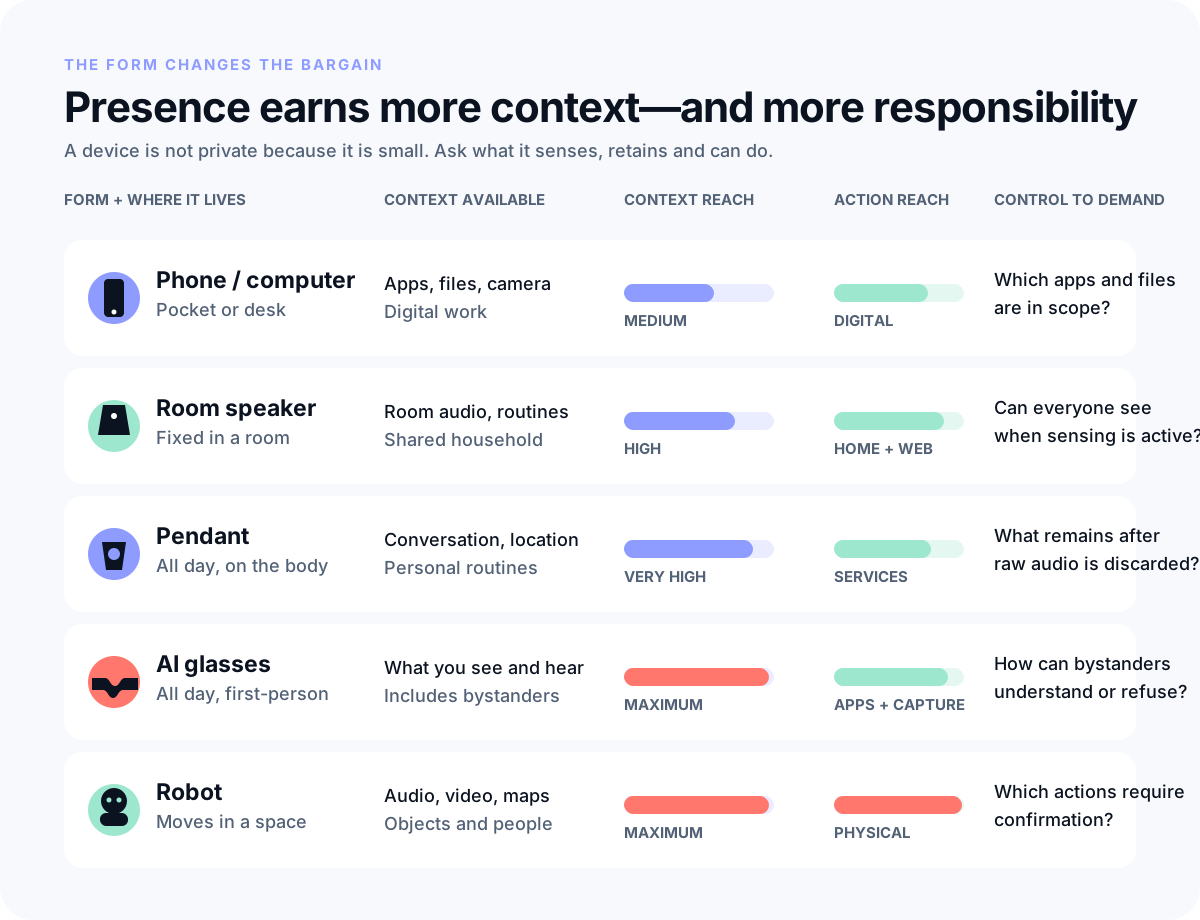
Original Maestro Brief comparison. The bars are qualitative orientation, not measured risk scores.
No form is automatically safer or more dangerous. A locally processed robot could retain less data than a cloud-connected speaker.
The bargain depends on sensor reach, retention, inference, action authority and local processing.
Everyone wants a place near you
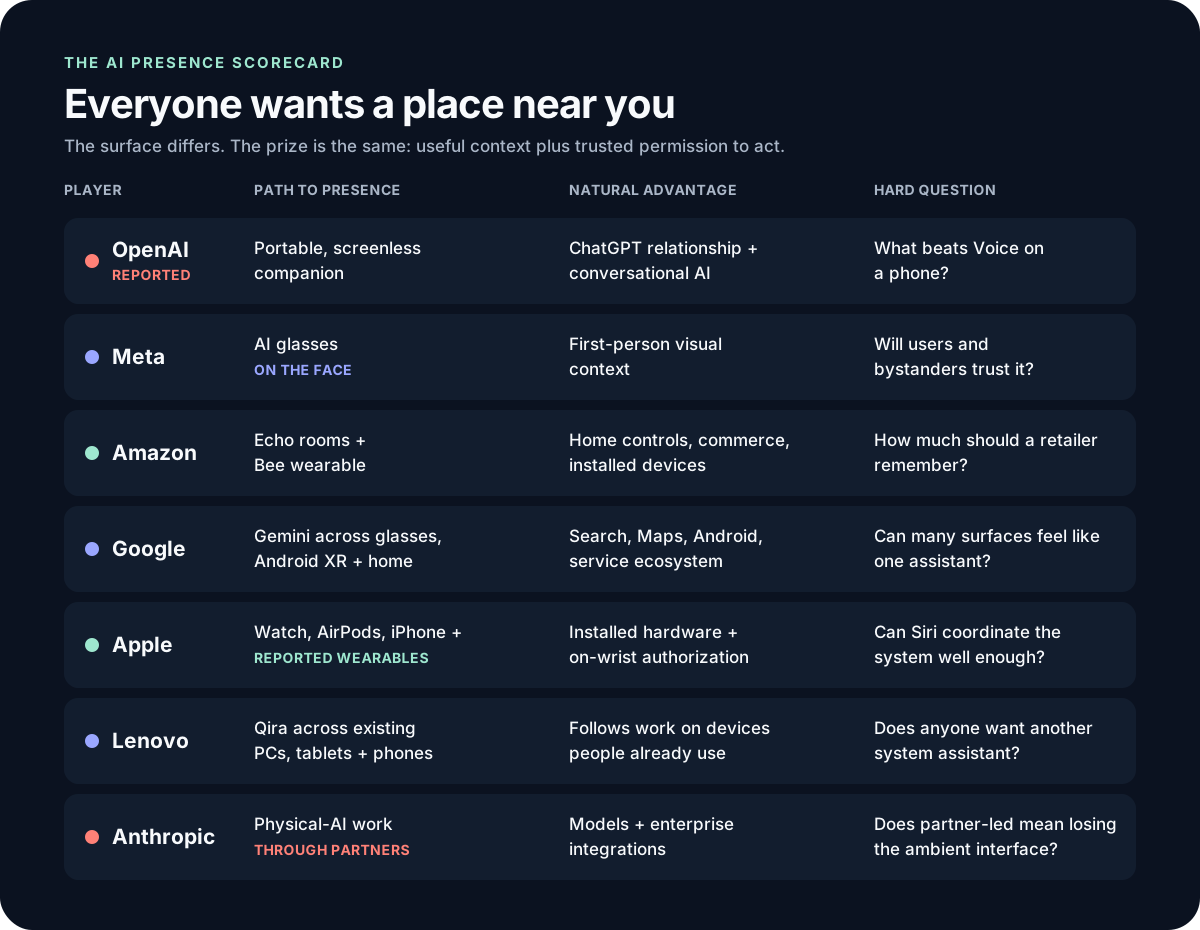
Original Maestro Brief scorecard. “Reported” marks hardware that had not been announced by the company as of publication.
Meta may have the strongest form factor.
Glasses go where you go. They can see what you see. Meta calls its glasses the ideal device for an all-day assistant. It has demonstrated practical uses such as reading menus, translation, navigation, taking photos and accessibility support.
Amazon may have the strongest home position.
Amazon says more than 600 million Alexa devices exist. Alexa+ can control smart-home devices and complete some service transactions. Amazon’s Bee wearable adds a portable memory layer built from conversations, notes and information the user chooses to connect.
Google is spreading Gemini across familiar surfaces.
Its coming audio glasses are designed to answer questions about what the wearer sees, provide directions, translate speech, send messages and hand tasks to phone apps.
Apple may turn the Watch into the permission layer
Apple is reportedly preparing glasses, a pendant and more capable AirPods. Bloomberg has also reported an exploratory Watch rethink that includes screenless wearable concepts. None of those hardware concepts is an announced product roadmap.
Apple has also reportedly shelved a Watch with a camera that could analyze its surroundings. That makes the more interesting possibility a distributed assistant rather than one all-seeing device.
Apple has confirmed that Siri AI is coming to supported Watches when paired with a nearby Apple Intelligence-capable iPhone. Apple has not announced the following workflow, but Maestro sees a promising architecture: glasses or AirPods could gather immediate context. The iPhone could supply compute, apps and connectivity. The Watch could become an on-wrist authorization surface, using private haptic prompts to request confirmation before consequential actions.
OpenAI may be trying to put ChatGPT into one new object. Apple can make AI feel present through several objects people already own.
That creates a useful design lesson. Separating sensing, reasoning, authorization and action can create clearer control points instead of asking one device to do everything. It can also create more cross-device data paths and failure points. The architecture is promising only if users can see which device knows what—and revoke it.
There is another strategy: do not make a new object. Lenovo’s Qira is meant to follow users across existing computers, phones and tablets. In the sources reviewed for this article, Anthropic had not announced a Claude consumer device as of August 10, 2026; its physical-AI work included an industrial-partner deployment. Maestro’s inference: a partner-led approach can avoid some hardware risk, but may surrender the interface that is present when life happens.
The buyer is not the only person in the room
The owner can accept terms. A child, visitor, coworker, patient or stranger may not know what the device is doing.
A recording light helps. It does not explain whether the device is transcribing, identifying speakers, inferring preferences, retaining memories or sending data to a model provider.
“We do not store raw audio” is also not the end of the question. Sensitive information can remain as a transcript, summary, embedding, inferred preference, voice identifier, memory, action log or backup.
A credible presence device needs an obvious physical mute. A camera shutter or equally strong control. A guest mode. Separate household and work identities. Inspectable memories. Per-event deletion. Clear retention periods. A way for bystanders to request removal when appropriate.
Workplace confidentiality and recording laws will vary. The hardware should not make compliance a guessing game.
OpenAI’s puck has five tests to pass
1. The phone test
Can it do something meaningfully better than ChatGPT Voice with a phone and earbuds?
Faster access is useful. It is not enough by itself.
The puck needs awareness that would be annoying to explain manually. It should understand who is speaking, what room it is in and which devices or tasks are relevant.
If every useful interaction begins with a long explanation, the phone wins.
2. The memory test
Voice is becoming a commodity.
Memory is the product.
A persistent assistant becomes valuable when it remembers the commitment you made yesterday, connects it to today’s calendar and notices that you still have not sent the document.
That same memory creates the product’s most uncomfortable questions.
Who was sensed? What left the device? What record remains? Can individual moments be deleted? Can work, family and guest contexts be separated?
“Trust us” is not a privacy control.
3. The action test
A clever speaker can answer questions.
A useful agent completes work.
It books the reservation after confirming the time. It turns off the correct lights. It sends the approved message to the intended person. It knows when an action requires another confirmation.
Personality cannot substitute for permissions, identity and an audit trail.
4. The replacement test
If the reported price above $300 is correct, the puck cannot survive as one more object to charge.
It has to replace enough phone, speaker or computer interactions to earn its place.
The price comparison is not flattering. Meta’s new AI glasses start at $299. Amazon sells much less expensive Echo devices. Google has not announced pricing for its coming audio glasses.
The sticker is only part of the cost. Buyers should include required subscriptions, paid AI plans and connected services.
A premium OpenAI object therefore needs a premium job.
“ChatGPT, but sitting over there” is not one.
The small Codex Micro reality check
OpenAI has already put its name on the $230 Codex Micro, a limited-edition control pad made with Work Louder. It shows Codex agent status through colored keys and provides tactile controls for switching chats, voice input and common actions.
One detailed owner review praised the build, status lights, fast chat switching and voice button. The same owner barely used some controls and recommended it mainly for people who juggle multiple tasks, like voice and can tolerate the price.
That is one person’s experience, not a representative survey. But it answers the gimmick question rather neatly: Micro solves a small problem for a small group. Everyone else already owns a keyboard.
It does not show that the puck will fail. It illustrates why attractive hardware still needs a painfully obvious job.
5. The survival test
Cloud-connected AI hardware has an expiration risk.
Humane shut down the AI Pin service after HP acquired parts of the company. Much of the hardware’s useful functionality disappeared with the cloud service.
Limitless stopped selling its AI memory pendant after Meta acquired the company. Rabbit continues updating the R1, showing that surviving AI hardware may require years of software changes after launch.
Buyers are not only purchasing hardware. They are betting that the company will keep operating the service.
Before buying, ask what works offline. Ask whether memories can be exported. Ask whether the hardware can be transferred or repurposed. Ask what happens when the subscription price changes—or the cloud disappears.
The business model lives in the room too
These assistants do not arrive without corporate incentives.
Amazon operates commerce and advertising businesses. Meta and Google operate enormous advertising platforms. OpenAI has launched a self-serve ChatGPT advertising platform. Apple sells integrated hardware and services.
That does not automatically make any product unsafe.
There is no evidence that OpenAI’s rumored device would use ambient data for advertising. OpenAI also says current ChatGPT ads remain separate from answers and that conversations are not shared with advertisers.
Still, privacy cannot be evaluated only by reading a sentence that says data is “secure.”
Readers should ask what is collected, what is retained, what trains models and how the company makes money. They should also ask whether recommendations can be influenced by ads, commissions, affiliate fees, preferred merchants or default services—and whether that influence is disclosed at the moment it matters.
The assistant that knows what you discuss, consider and purchase can be wonderfully helpful.
It can also become the most intimate recommendation engine ever placed on a kitchen counter.
Maestro’s verdict
OpenAI’s rumored puck is interesting.
Not because it looks like a doughnut. Not because it may move. And not because Jony Ive can make a microphone look emotionally available.
It is interesting because it reveals the destination.
AI companies want to leave the browser. They want to be present before you ask. They want enough context to become useful and enough permission to act.
The company that wins will make that feel natural.
The company that loses may still produce a very attractive paperweight.
The stupid-simple test
Before buying, ask five questions:
- What does it sense, and what leaves the device?
- What remains after raw audio or video is discarded?
- Can sensing be unmistakably paused and individual memories deleted?
- Which actions require confirmation, and can they be undone?
- What is the total subscription cost, and what survives without the cloud?
A presence device earns its place only when it removes real friction and makes those answers obvious.
Do not buy one because the light blinks thoughtfully.
Developers should apply the same test to the services these devices call. Require confirmation for consequential actions. Show what the agent did. Make actions reversible. Separate personal, work and household context. Assume bystanders did not consent.
When OpenAI eventually announces the product, ignore the shape. Watch the permissions demo.
If personality gets more stage time than memory, deletion, identity and risky-action controls, keep your phone.
Sources considered
- Bloomberg: reported portable, screenless AI companion
- TechCrunch: summary of the reported movable, screenless companion
- TechRadar: summary of the later Bloomberg-reported form and $300–$400 range
- Forbes: summary of Bloomberg’s reported 2027 release target
- OpenAI: Codex Micro product details and price
- Reddit: one Codex Micro owner’s detailed review
- Meta: Meta Glasses
- Meta: accessibility uses for AI glasses
- Google: Gemini intelligent eyewear
- Amazon: Alexa+
- Amazon: Bee wearable
- Lenovo: Qira ambient intelligence
- Bloomberg: Apple’s reported AI wearable projects
- Bloomberg: Apple’s exploratory Watch redesign concepts
- Bloomberg Law: Apple shelved a Watch camera project
- Apple: Siri AI integration across Apple Watch and other devices
- Anthropic: Claude in physical-AI engineering
- Axios: Humane’s shutdown and HP transaction
- Rabbit: R1 product updates
- Limitless: acquisition and service notice
- Axios: OpenAI’s self-serve ChatGPT advertising platform
- OpenAI: current advertising principles and advertiser data boundaries
This is original Maestro research and analysis. The opinions and summaries are AI-generated, then independently reviewed against the linked sources. Reported hardware, pricing and release timing may change before any product is announced.