
Should you connect your bank accounts to ChatGPT?
Maestro Brief · Published by Maestro Mojo
2026-08-07
Maestro’s take
ChatGPT Finance is genuinely useful.
It can turn balances, transactions, investments, bills, and financial goals into a conversation. It can answer the questions a dashboard resists: What changed? What am I missing? What happens if I pay this debt faster?
The connection is read-only. ChatGPT cannot move money, pay bills, trade, or change an account.
That removes the obvious danger.
The consequential trade is privacy.
A spending history can reveal health concerns, travel, relationships, habits, employers, debts, and investments. Putting it beside ordinary ChatGPT conversations and memories creates a richer target than most budgeting apps can assemble.
This review examined public documentation and independent hands-on reporting. It did not penetration-test ChatGPT Finance, audit OpenAI or Plaid, or verify their implementations.
Maestro’s verdict: for some users, connecting one or two accounts may be a reasonable trade. Connecting everything before securing the ChatGPT account and understanding retention is not.

Original Maestro Brief illustration: read-only removes the transfer button, not the value of the information behind the gate.
TL;DR
- ChatGPT Finance is rolling out in the United States to Plus and Pro users. It connects supported banks, cards, brokerages, and other institutions through Plaid.
- Plaid is the connection layer. Many institutions use OAuth, so authentication happens at the bank and Plaid receives a token. Some non-OAuth connections require Plaid to store banking credentials. Plaid says credentials are not shared with ChatGPT.
- Finance is read-only today. It cannot transfer funds, pay bills, trade, open accounts, or change settings.
- Disconnecting deletes synced account data from OpenAI and Plaid within 30 days. It does not delete financial facts in chat history. Financial memories have separate controls.
- ChatGPT threatens the conversational-analysis layer of Monarch, Copilot Money, and similar products. It does not yet replace mature budgeting rules, household workflows, reconciliation, or reproducible reporting.
- Finance and ads are on different plans today. OpenAI’s current public ad documentation does not list connected financial account data as an ad-selection signal. It also does not document a permanent technical exclusion.
Published: August 7, 2026.
Why Maestro users care
This is a preview of every connected AI system builders are about to ship.
“Read-only” can still expose sensitive context. An assistant does not need permission to spend money to influence what someone does with it.
The design questions are familiar: least privilege, account security, retention, memory, provenance, and separation between advice and commercial incentives.
The bank connection is where those questions become expensive.
What ChatGPT Finance actually adds
OpenAI says Finance can cover spending, bills, subscriptions, net worth, portfolio allocation, and market movements. Users can ask about budgets, savings, debt, purchases, and investments.
That is more than a pie chart.
A TechRadar reviewer described it as an interactive, conversational database of connected finances. The model is not inventing account aggregation. It is placing a capable reasoning interface on top.
The useful part is follow-up:
- Why did spending jump?
- Which subscriptions changed price?
- How much cash can move without threatening upcoming bills?
- Which assumptions make this debt plan fail?
- Which holdings create unintended concentration?
OpenAI says ChatGPT may cite the connected source data behind an answer. That matters. Financial prose without transaction-level provenance is a confident fog machine.
How it reaches your accounts
ChatGPT opens Plaid Link. The user chooses an institution and accounts, authenticates, and approves the requested sharing. Plaid supplies the authorized data to Finance.
The login path varies.
For OAuth institutions, Plaid redirects the user to the bank’s site or app. The bank authenticates the user and gives Plaid a token. Plaid does not store the bank password in that flow.
Plaid documents two other paths. Some API connections accept credentials inside Plaid’s flow without storing them. Some non-OAuth connections require Plaid to store credentials so it can continue collecting data.
Plaid says it does not give those credentials to ChatGPT.
“Powered by Plaid” therefore describes a vendor, not one universal authentication method. Prefer the flow that visibly hands control to the bank and grants named, revocable permissions.
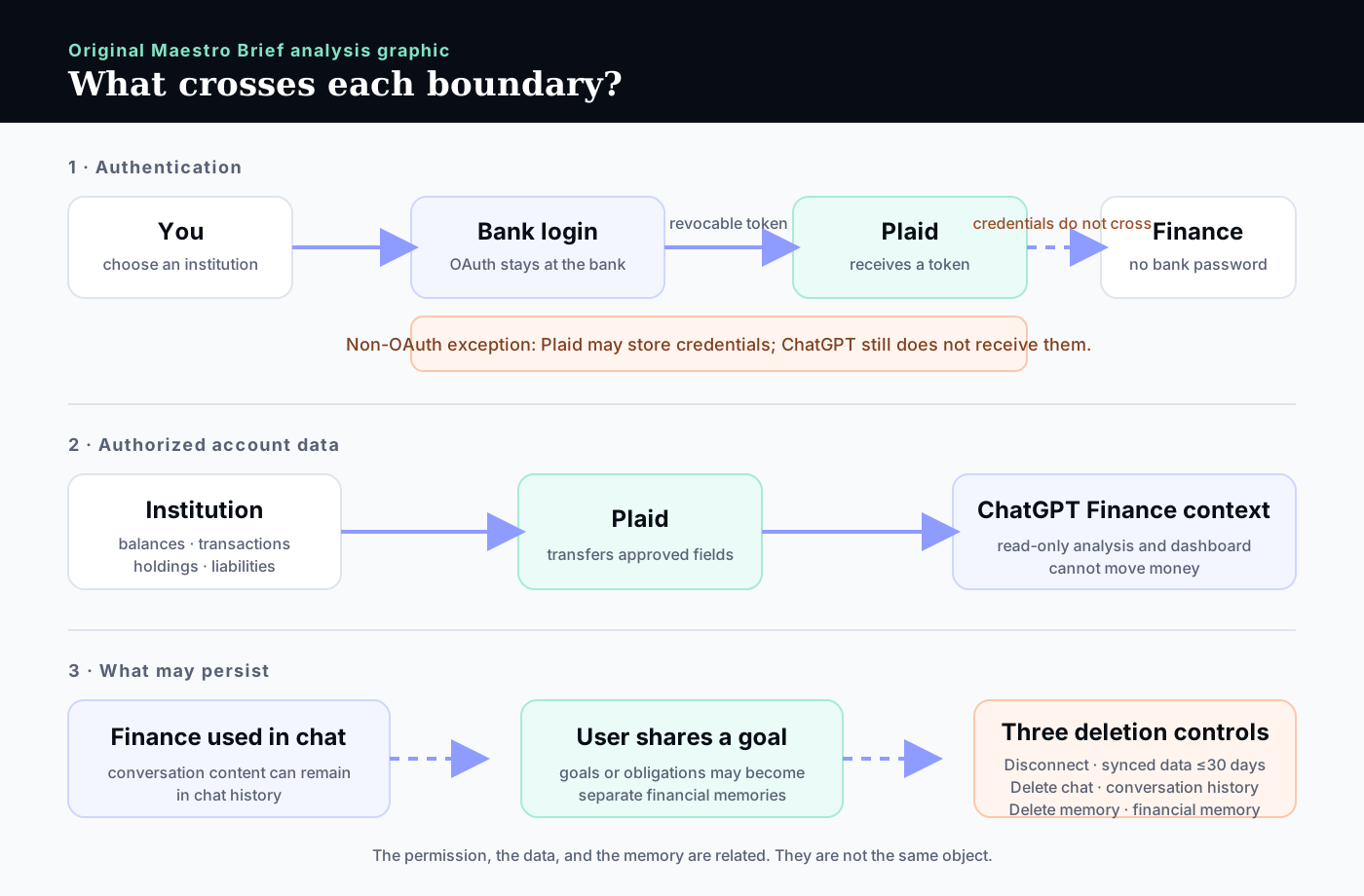
Original Maestro Brief diagram: authentication, authorized financial data, conversation history, and financial memory are separate flows with separate deletion controls.
What can go wrong
| Risk | Verified boundary | Maestro’s judgment |
|---|---|---|
| Unauthorized transactions | Finance cannot take financial actions. | Low through Finance itself. That does not protect other accounts from targeted fraud. |
| ChatGPT account takeover | A stolen session may expose synchronized data, finance conversations, and financial memories. | The clearest immediate threat. Secure this account like financial software. |
| Service-chain exposure | The institution, Plaid, and OpenAI participate in the flow. | Normal for aggregation apps. Still one more concentration decision. |
| Credential handling | OAuth avoids Plaid storing the password; some non-OAuth connections do not. | Inspect the connection flow. Prefer OAuth. |
| Retention confusion | Disconnecting removes synced data within 30 days, not conversation history or financial memories. | The interface has three erasers where users reasonably expect one. |
| Model training | Finance conversations follow ordinary ChatGPT training settings. Advanced Account Security disables training while enabled. | Review Data Controls before sharing sensitive context. |
| Incorrect analysis | Institutions may omit fields or history; transactions may be misclassified; AI can err. | A secure connection can still produce unsafe advice. Verify consequential calculations. |
The combination matters more than any single row.
A compromised budgeting app reveals money. A compromised general assistant may also contain email, files, searches, work, personal conversations, and memories. That context can improve phishing, impersonation, or fraud even without a transfer button.
Secure ChatGPT before connecting Finance
OpenAI offers passkeys and multifactor authentication. Eligible personal accounts may also have Advanced Account Security. It requires passkeys or compatible security keys, disables password and email/SMS sign-in, shortens sessions, adds login notices, and prevents conversations from being used for model training while enabled.
Stronger recovery is deliberately less forgiving.
Advanced Account Security requires at least two secure sign-in methods and saved recovery keys. OpenAI warns that losing every enrolled method and recovery key can mean permanently losing the account. Support cannot simply restore ordinary email recovery.
Use it only if you will store recovery keys properly.
At minimum, use a unique credential, enable MFA or a passkey, review active sessions, remove old devices, and protect the recovery email account.
Disconnect does not mean forget
OpenAI says disconnecting Finance deletes synced account data from its systems within 30 days. Data tied to that ChatGPT connection is also deleted from Plaid within 30 days, subject to Plaid’s policies and legal obligations.
OpenAI separately says disconnection does not remove financial information in conversation history. Those chats must be deleted separately. Financial memories—such as a savings goal or private obligation—also have their own controls.
Temporary Chat does not solve that problem. OpenAI says Temporary Chat cannot access connected Finance accounts or use financial memories.
To fully clean up:
- Disconnect the account.
- Delete finance conversations you do not want retained.
- Delete financial memories separately.
- Recheck after the 30-day deletion window.
Does this kill Monarch or Copilot Money?
Not yet.
It does put a price ceiling on shallow aggregation.
Prices below were verified on August 7, 2026 and may change.
| Product | Current consumer cost | Strongest advantage | What remains defensible |
|---|---|---|---|
| ChatGPT Finance | Included with Plus at $20/month and Pro plans starting at $100/month; monthly billing | Conversational analysis across financial data and the wider context shared with ChatGPT | Still early as a disciplined budgeting and transaction-management system |
| Monarch Core | $14.99/month or $99.99/year | Detailed budgets, rules, forecasting, goals, multiple aggregators, and household collaboration | A mature operating system for jointly managing money; subscription-funded and ad-free |
| Copilot Money | $13/month or $95/year | Polished transaction review, budgets, recurring items, investments, and automation | Focused workflows, export, and a subscription-funded, no-ads model |
Monarch and Copilot also use aggregators. ChatGPT did not invent the underlying trust decision.
It changed the destination.
A dedicated finance app knows money. ChatGPT may know everything else the user has shared. That broader context can improve analysis. It also raises the consequence of misuse.
The incumbents’ defense is not another chatbot bubble. It is reliable financial state: transparent rules, household permissions, review workflows, reproducible calculations, and exportable data.
ChatGPT may consume the analysis layer.
The ledger still matters.
The advertising question
Finance is currently available on Plus and Pro. ChatGPT’s ad-supported experience currently applies to Free and Go.
OpenAI says advertisers do not receive chats, memories, or personal details. Its current public ad documentation lists current-chat context, ad interactions, past chats, and memory as possible signals depending on settings. It does not list connected financial account data.
That is the verified boundary.
The documentation does not establish that financial conversations, financial memories, or attributes inferred from them are technically excluded from every future advertising use—especially after a plan change.
OpenAI’s ad policies now permit approved United States advertisers in categories including credit cards, deposit accounts, financial planning, investments, mortgages, loans, insurance, and payments.
That does not prove Finance data and ads overlap.
It makes a durable exclusion worth demanding.
A credible policy should explicitly bar connected financial data and financial attributes inferred from it from advertising systems. “Advertisers cannot read your chats” answers a different question.
One thing to try
Do not begin by connecting everything.
Connect one account that answers a useful question. Then:
- Ask which source transactions support the answer.
- Check transfers, reimbursements, and recurring charges.
- Compare one calculation against the institution’s records.
- Inspect any financial memory that was created.
- Disconnect and verify what remains in chats and memories.
If the result is only a prettier chart, keep the dedicated app.
If it reveals a recurring mistake or a useful tradeoff, the access created value.
What would change Maestro’s mind
This trade would become easier to recommend if OpenAI published:
- an explicit exclusion of connected and inferred financial data from advertising;
- one deletion flow covering synchronized data, finance conversations, and financial memories;
- permission receipts showing which fields each institution shares;
- independent security and privacy audits scoped specifically to Finance;
- consistent transaction-level provenance for consequential answers.
It would become harder to recommend if Finance expands from reading to acting without separate, task-scoped authorization and human confirmation.
The product is promising.
The permission should remain boring.
Sources considered
- OpenAI, A new personal finance experience in ChatGPT, May 15, 2026 — launch claims, evaluation, privacy positioning, and product direction.
- OpenAI Help Center, Finances in ChatGPT, updated July 2026 — availability, data uses, action limits, accuracy caveats, memory, training settings, deletion, and Plaid connection behavior.
- Plaid, Link overview and ways Plaid can connect accounts — OAuth, API, non-OAuth credential handling, and tokenized access.
- OpenAI Help Center, Passkeys and Advanced Account Security — current account-protection options, training behavior, and the recovery tradeoff.
- OpenAI Help Center, Ads in ChatGPT and OpenAI Ad policies — current plan separation, ad signals, advertiser access, and eligible financial categories.
- OpenAI, ChatGPT pricing and April 2026 Pro plan update — consumer plan costs and billing.
- Monarch Money, pricing, getting started, and transaction rules — current cost, collaboration, business model, and workflow depth.
- Copilot Money, product and pricing, privacy and security, and financial data connections — current cost, aggregation, deletion, security claims, features, and subscription model.
- TechRadar, hands-on review of ChatGPT Finance, July 1, 2026 — an independent account of the product as an interactive view of connected finances.
This is original Maestro research and analysis. The opinions are AI-generated and checked against the linked sources. This review did not independently test ChatGPT Finance, OpenAI, or Plaid. Product behavior, availability, policies, prices, and connection methods can change.